COMPLEMENTATION BY
FINITE CLAUSES
The concept of embedding was introduced in relation to clauses. In a sentence such as The doctor knows that you are waiting, we say that the subordinate clause that you are waiting is embedded in the main clause The doctor knows. Another term is the matrix.
The embedded clause, introduced by a complementizer (subordinator), functions as a non-prototypical direct object.
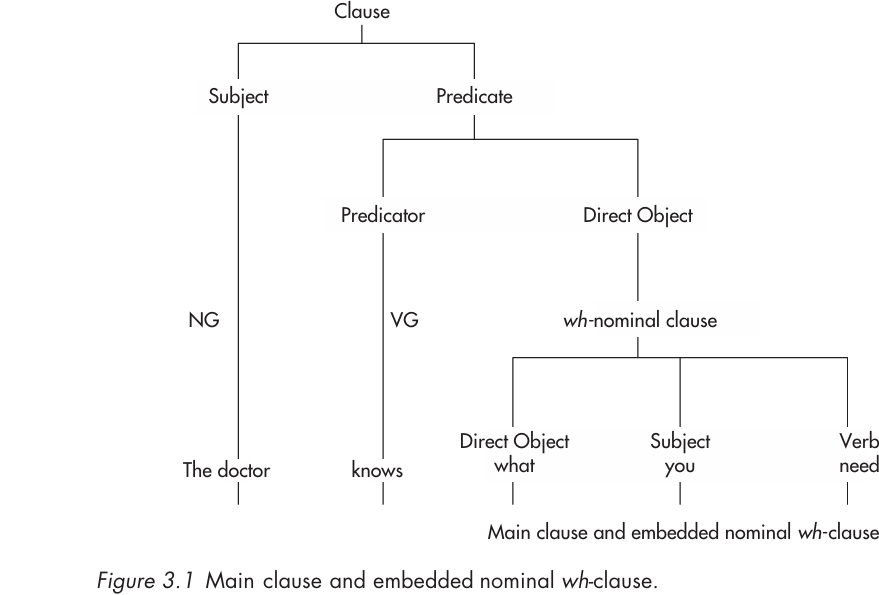
The complementizer that has little semantic value and is purely functional. By contrast, a wh-word has meaning and functions as a constituent of the embedded clause, as in The doctor knows what you need. The structure of this sentence is shown in the following diagram.
The main verb is said to determine or control the dependent clause.
Here, the clauses will be discussed as realizing Object and Complement functions (Cs and Co).
The four main types of dependent complement clause are: that-clauses, wh-clauses, to-infinitive clauses and -ing clauses. They are distinguished by their complementizer (subordinator) such as that or a wh-word, and by their own structure. They are shown here complementing monotransitive verbs.
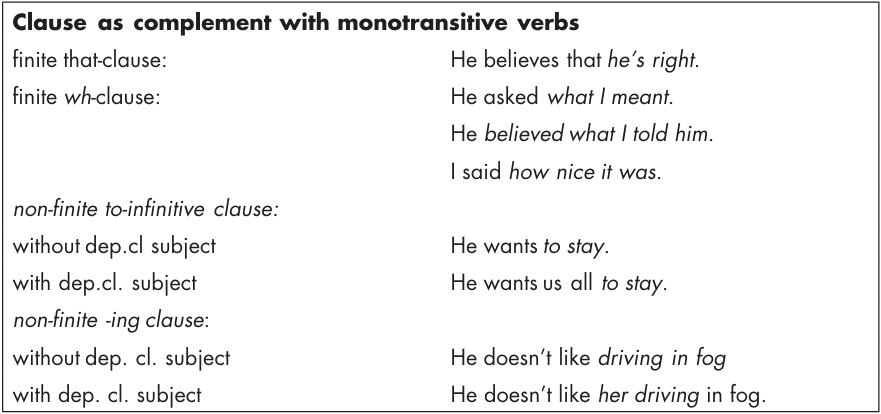
That-clauses and wh-clauses are finite, having a subject and tense-modality features, while to-infinitive and -ing clauses are non-finite, and lack these distinctions. All of these types can be used to complement verbs and adjectives. Less versatile are the ‘bare’ infinitive (He helped me carry the bags) and the -en participle clause, which occurs in the complex-transitive structure (I heard two shots fired).








