Type 6: V + NG + -ing clause – I saw them waiting
Pattern I with verbs of perception and discovery such as see, hear, feel, smell, find, leave, catch, discover, come across, keep
The subject of the -ing clause is also the object of the superordinate clause. It can become subject in a passive clause.
They caught him stealing from the till. He was caught stealing from the till.
She found the child sleeping peacefully. The child was found sleeping peacefully.
Note that verbs of starting, stopping and continuing among others, when followed by either to-infinitive or -ing clauses, are analyzed not as lexical verbs followed by a complement, but as concatenated verbal groups that express aspectual meanings such as ingressive, egressive and continuative, as in He started smoking at the age of fifteen.
Pattern 2 with verbs of retrospection such as regret, remember and forget (but not recall, which takes only -ing) mark a difference of time reference in relation to the main verb. With a to-infinitive clause, the action expressed is seen as following the mental process of remembering or forgetting, whereas an -ing form marks the action as previous to the mental process:
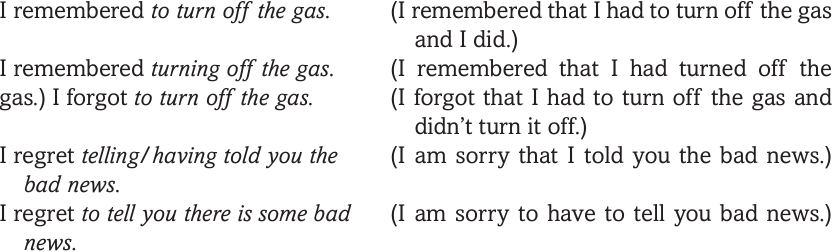
Regret + to-infinitive is always followed by a verb of communication – say, tell, announce, inform – used with present time reference. Both the regretting and the telling occur at the moment of speaking, whereas regret + -ing has no such limitation (She regretted going out without an umbrella).








