SPEECH ACTS AND
CLAUSE TYPES
THE BASIC CORRESPONDENCES
When we speak or write to each other, we perform acts through words, such as thanking and promising. These are ‘speech acts’. Certain general types of speech act are very basic, in that most, if not all, languages have ways of representing them by means of the grammar. These are statements, questions, exclamations and directives.
These basic speech acts are encoded in the grammar in the system of clause types or moods, as shown in the diagram below. The indicative is the grammatical category typically used for the exchange of information, in contrast to the imperative, which grammaticalizes our acting on others to get things done by requesting, ordering and so on. The exclamative grammaticalizes the expression of emotion.
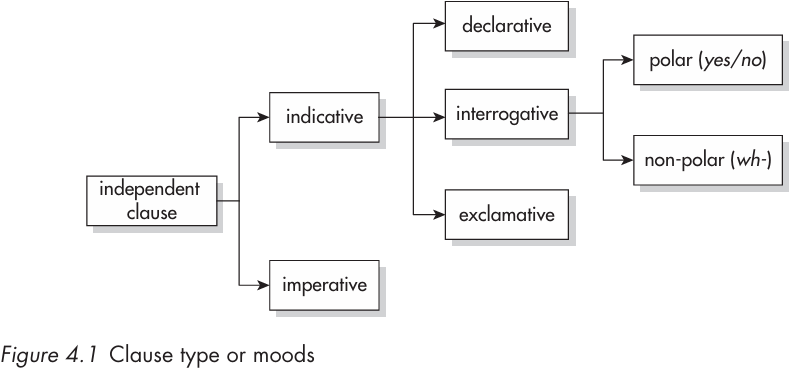
Interrogative clauses can be either polar (yes/no interrogatives) or non-polar (wh- interrogatives).
The basic correspondences between clause types and speech acts are summarized as follows:
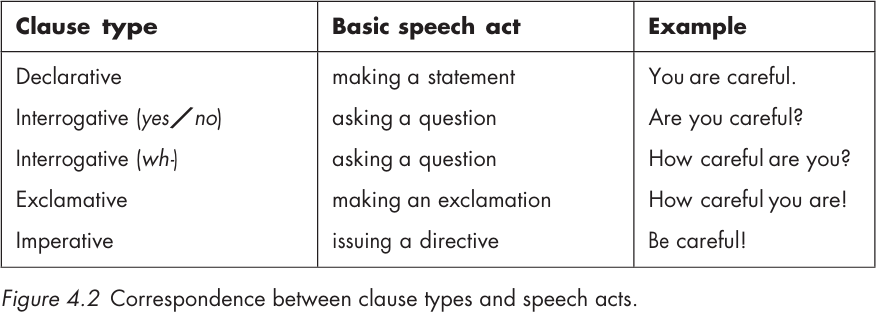
The traditional term ‘command’ is nowadays applicable only in contexts of great inequality and power such as the military. The term directive is used instead in everyday environments, to cover such acts as requests, prohibitions and instructions, as well as orders and commands.








