Dual detector systems
The simultaneous use of a combination of a universal detector (FID) with a specific detector to monitor the effluent of a column can provide useful information about the properties of functional groups and substituents in a molecule. The FID response is roughly dependent on the number of carbon atoms in a molecule and is quite predictable. However, the ECD response varies widely for different compounds, is dependent on the electron-deficient part of the compound, and is difficult to predict. The NPD response of a compound depends to some extent on the number of phosphorus or nitrogen atoms in a molecule, but it also depends on their environment. Thus, by using the FID as a reference, and measuring the ECD or NPD response relative to it, another characteristic for identification is obtained in addition to retention behaviour (see Fig. 1).
Dual detector systems can be used in several ways. The column can be split at the detector end and the effluent passed into two different detectors that operate in parallel. This approach allows the most flexibility, since the choice of detectors is wide, and the effluent can be split in proportion to the sensitivity required from each detector. For capillary columns this is accomplished easily with zero dead volume press-fit tee connectors, but it is a more complicated operation for packed columns. Additional makeup gas may be required to ensure a good flow through the detectors, and care should be taken to use tubing of area smaller than or equal to the total area of the analytical column to avoid loss of peak shape through refluxing at the detector. Alternatively, the GC oven houses two completely separate but identically matched columns, each connected to a single detector. This is not an ideal approach, as matching of columns is difficult and has to be checked at frequent intervals. Another approach is to stack the detectors in series, and some manufacturers deliberately provide detectors in identical modules for this purpose. There are limitations to the choice of possible detector combinations, as the first detector must always be a nondestructive detector, such as the ECD, AED or FTIRD.
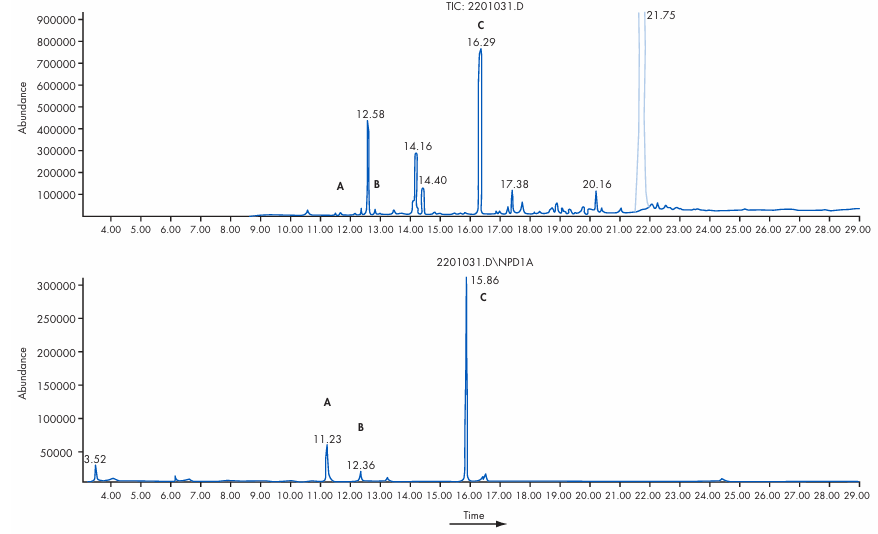
Figure 1 Analysis of basic drugs in blood using dual GC-MS and GC-NPD detection. A, caffeine; B, propy phenazone; C, proadifen (used as internal standard for the analysis). Upper trace: GC-MS TIC chromatogram. Lower trace: GC-NPD chromatogram. Several nitrogen-containing drugs barely detected by GC-MS in scan mode are clearly detected by the NPD detector, indicating the high sensitivity of NPD. The lower chromatographic trace is much simpler, indicating the high specificity offered by NPD detectors. Note: there is a slight difference in retention times between the two columns because columns of different length were used for the analysis. (Reprinted from A. Beat and Werner, Gas chromatography with dual mass spectrometric and nitrogen-phosphorus specific detection: a new and powerful tool for forensic analyses, Forensic Science International, 1999, 102, 11, with permission from Elsevier.)








