Isolation and concentration
Solid-phase microextraction
Solid-phase microextraction (SPME) requires no solvents or complicated apparatus and can concentrate volatile and nonvolatile compounds in both liquid and gas samples. The unit consists of a fused-silica fibre attached to a stainless-steel plunger coated with a stationary phase (mixed with solid adsorbents as required). The plunger is inserted through a septum into a vial that contains the sample, and the fibre is exposed by depressing the plunger either into the liquid or the headspace for 20–30 min. The retracted fibre is inserted into the injection port of the GC, and is desorbed when the plunger is depressed (Fig. 1). The unit may be reconditioned and used 50 to 100 times. For field analysis, adsorbed samples can be stored and transported in the needle sealed in a special container for subsequent analysis by GC (or LC). Pesticides recovered from water samples have been shown to be more stable when stored in this way than in water. The special small-volume injection liner fits any model of chromatograph, and produces sharper peaks because of the higher linear gas velocity, with little or no backflush. Suitable stationary phases are:
• 100lm dimethyl-PSX film for low-molecular weight compounds or volatiles, or a thinner film (7 μm) for higher-weight semi volatile compounds
• 85lm polyacrylate film for polar compounds
• 65lm film of dimethyl-PSX–divinyl benzene for volatile alcohols and amines
• for surfactants, 50 μm Carbowax-templated resin
• for trace level volatiles, a 75 μm Carbowax–carboxen phase is suitable.
An alternative approach uses a small magnetic stir bar encapsulated in glass and coated with a layer of dimethyl-PSX. The bar is left to stir in the sample for 30–120 min and then removed and placed in a thermal desorption tube. From there, it is introduced onto the GC as described in the section on thermal desorption injectors. Both approaches give similar performance for higher-boiling compounds (>350C), but SPME is inferior for lower-boiling com pounds such as naphthalene and fluorene.
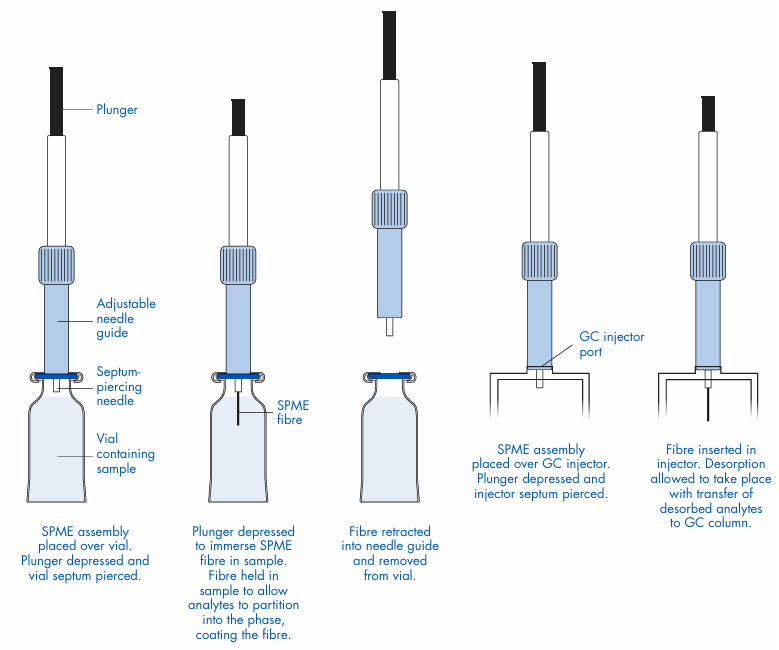
Figure 1 Extraction using solid-phase microextraction (SPME). The SPME fibre is coated with a phase similar to the types of stationary phases used in GC. Analytes partition into the phase and hence are extracted from solution. It is also possible to carry out headspace analysis using SPME in which case the fibre is held in the headspace above the sample.








