
Isolation and concentration , Solid–liquid or solid-phase extraction
 المؤلف:
Sue Jickells , Adam Negrusz (Editors)
 المصدر:
Clarkes Analytical Forensic Toxicology
 الجزء والصفحة:
p500-501
 2026-11-25
 23
Isolation and concentration
Solid–liquid or solid-phase extraction
Solid-phase extraction (SPE) uses a polypropylene cartridge with a small amount (200 mg to 3 g) of high-capacity (1–20 mL) silica-based packing at the base of the reservoir. On intro duction of the sample matrix, the compounds of interest are withheld by the packing. Impurities are then rinsed selectively from the column, and the final elution releases the compound of interest (Fig. 1).
Evaporation followed by reconstitution in a suitable solvent provides a clean, concentrated sample ready for analysis by GC. Bonded-phase packings that have been modified by the addition of various functional groups are available. The mechanisms of interaction for the matrix, analytes and packings are similar to those in liquid chromatography . Polar stationary phases preferentially retain polar analytes (normal phase) and are eluted with organic solvents, while nonpolar stationary phases preferentially retain nonpolar analytes (reversed phase) and are eluted with aqueous solvents. Ion-pair extraction uses a nonpolar stationary phase and polar analyte, with a counterion added to the sample solution, and allows retention of the (now neutral) analyte by a reversed-phase mechanism. In ion-exchange extraction, the adsorbent surface is modified with ionisable functionalities. Analytes with ionic charges opposite to those on the packing are retained. Solvents that contain counterions of greater strength are used to elute the analytes of interest from the tube.
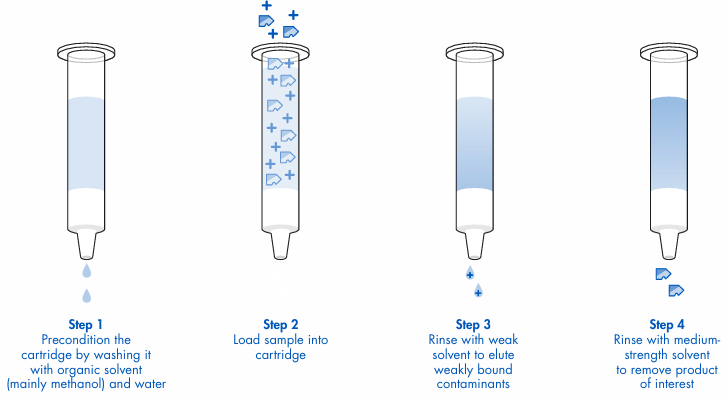
Figure 1 Steps involved in SPE.
 0
 0
 الاكثر قراءة في تحليل السموم
 اخر الاخبار
اخبار العتبة العباسية المقدسة








