Derivative formation
The main reasons derivatisation is performed are:
• to permit analysis of compounds not directly amenable to analysis owing to inadequate volatility or stability
• to improve the analysis by improving chromatographic behaviour or detectability. To some extent the availability of stable polar stationary phases in capillary columns and the use of temperature programming has negated the requirement for derivatisation, although it is still widely used. Choice of reagent is based on the functional group that requires derivatisation, the presence of other functional groups in the molecule and the reason for performing the reaction. Although the retention characteristics are changed, the order of elution of a series of derivatives will be the same as that for the parent compounds. The preparation of derivatives modifies the functionality of the solute molecule to increase (or sometimes decrease) volatility, and thereby shortens or lengthens the retention time of a substance, or to speed up the analysis. The major derivatisation reactions for GC are silylation, alkylation and acylation. Silylation is usually used as an abbreviation for trimethylsilyl Tion. Examples of derivatising agents include: N,O-bis(trimethylsilyl)trifluoro acetamide (BSTFA); a mixture of BSTFA and trimethylchlorosilane (TMCS); N-methyl trimethylsilyl trifluoroacetamide (MSTFA); N methyl-N-(t-butyldimethylsilyl) trifluoro acetamide (MTBSTFA); and others. Typically, derivatives are formed by replacement of active hydrogens from acids, alcohols, thiols, amines, amides, ketones and aldehydes with the trimethylsilyl group.
Alkylation. Typical derivatives are formed by replacement of an active hydrogen (carboxylic acids and phenols) by an aliphatic or aliphatic aromatic (i.e. benzyl) group. The reagents include3 M HCl in butanol or N, N-dimethyl form amide dimethyl acetal. Acylation is the conversion of compounds that contain active hydrogen (1OH, 1SH, and 1NH) into esters, thioesters and amides, respectively. Typical derivatising reagents include heptafluoropropionic anhydride (HFPA), pentafluoropropionic anhydride (PFPA), and others. An example of a derivatising reaction is presented in Fig 1.
Derivatisation can improve resolution and reduce tailing of polar compounds (hydroxyl, carboxylic acids, hydrazines, primary amines and sulfhydryl groups). For instance, hydroxyl ated compounds often have long retention times and column adsorption causes tailing, which results in low sensitivity. However, they readily form silyl ethers and these derivatives show excellent chromatography; sensitivity can often be improved by a factor of 10 or more.
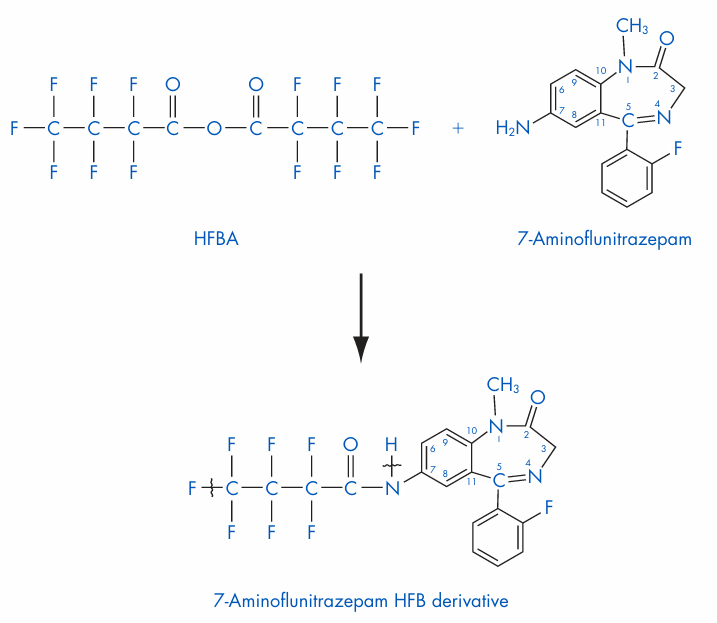
Figure 1 Derivatisation of 7-aminoflunitrazepam with heptafluorobutyric anhydride (HFBA).
Derivatisation can also help to remove the substance peak away from interfering material. Derivatives may also be used to make the molecule amenable to detection by selective detectors (e.g. introducing halogens to the molecule can increase detectability by an electron capture detector, see Fig 1), or can be used to improve the fragmentation pattern of the compound in the mass spectrometer.
Derivatisation reactions may be carried out during extraction (e.g. extractive alkylation), on the dry residue after solvent extraction (e.g. silyl ation), or during injection (e.g. methylation). In choosing a suitable reagent, certain criteria must be used. A good reagent produces stable derivatives without harmful by-products that interact with the analytical column, in a reaction that is almost 100% complete. Poor reagents cause rearrangements or structural alterations during formation, and contribute to loss of sample during reaction. Most manufacturers of derivatising reagents provide information on the potential uses of each product, along with stand ard operating instructions. Entire texts, such as that by Blau and Halket (1993), are devoted to this topic.








