Mood
Bybee (1985:22) defines mood as an indication of “what the speaker wants to do with the proposition” in a particular discourse context. In other words, mood is a grammatical reflection of the speaker’s purpose in speaking.
Linguists refer to the DECLARATIVE, IMPERATIVE, and INTERROGATIVE moods as MAJOR MOOD categories. Each of these categories corresponds to one of three basic speech acts: statements, commands, and questions, respectively. These are perhaps the most straightforward examples of how mood indicates “what the speaker is doing.” Most of the examples we have considered up to now have been statements expressed in the declarative mood. We will introduce some other mood categories which are found in a number of languages. Then, we will discuss MODALITY.
Some linguists do not distinguish between MOOD and MODALITY (or MODE), using one label or the other as a cover term for all the categories discussed below. We will attempt to maintain a distinction between these terms along the lines suggested at the beginning: MOOD (as we have just said) is an expression of what the speaker is trying to do, so certain moods are closely associated with particular speech acts. MODALITY expresses (i) the speaker’s attitude toward the proposition being expressed (e.g. his degree of certainty about whether it is true or not); or (ii) the actor’s relationship to the described situation (e.g. whether he is under some kind of obligation to act in a certain way).
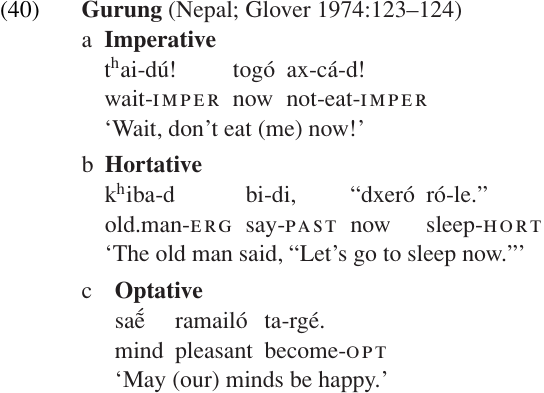
Some languages have a special mood for softened commands or exhortation, often called the HORTATIVE. Hortative mood is often used with first person inclusive reference, as in the English pattern Let’s go! Another similar category is the OPTATIVE, which marks something the speaker hopes for, or wishes would be true. Note the following three-way contrast in Gurung:
SUBJUNCTIVE is a category used to mark propositions which the speaker does not assert to be true. English still retains a few traces of subjunctive inflected forms, mostly in archaic or frozen expressions. These can be recognized by the failure of normal subject–verb agreement patterns:
(41) English subjunctive examples:
a If I were you, I wouldn’t do that.
b God bless you!
c Long live the king!
The most common context where subjunctives may be required is in conditional (41a) or contrafactual constructions, e.g. If you had been on time, we could have caught that bus. The subjunctive may also have optative and/or hortative uses in main clauses (42b–c), and it may be required in certain kinds of dependent clauses. The following examples show some of the uses of the subjunctive in Latin:
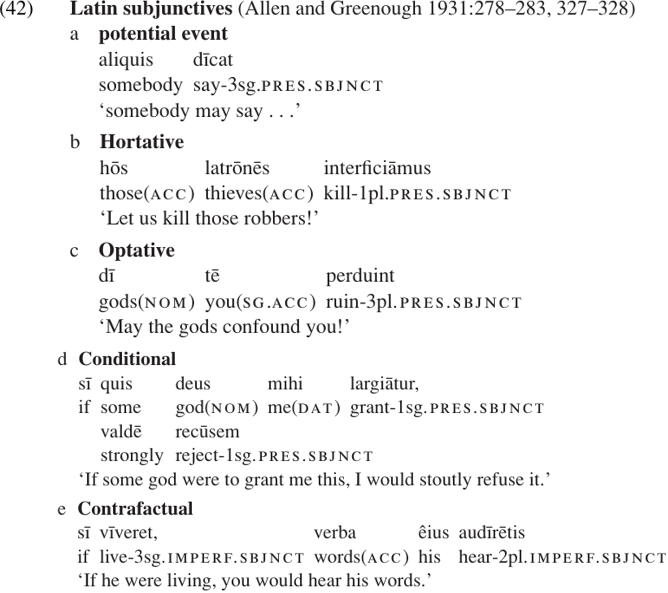
The subjunctive, optative, and hortative moods are similar in certain important ways. All of them indicate that the speaker is not asserting the truth of the proposition expressed by the clause, and that the situation described by the clause is not an actual one. For this reason, the three are sometimes referred to as the “irrealis” moods.
We have seen that there is often an association between irrealis mood and future tense, in tense systems that distinguish future vs. non-future, because future tense expresses situations which are not yet actual. These categories may also span the boundary between mood and modality. The optative and hortative moods can be associated with specific speech acts (wishing and exhorting) or intentions, and so fit into our basic definition of mood. But certain uses of the subjunctive (e.g. that in 42a) seem to relate primarily to the speaker’s degree of certainty about what he is saying. This is a type of modality, the category to which we now turn our attention.








