Content questions
In content (or information) questions, a question word replaces one of the constituents of the corresponding declarative sentence (see (21)). This question word is always the focused element of the question, representing the crucial piece of new information that is being requested. With regard to the structure of the content question, the first issue to be addressed is: where does the question word appear in the sentence? Most languages use one of two basic strategies: either the question word appears at the beginning of the sentence, 1 as in English, or the question word appears in the place where the constituent which it replaces would normally occur in a declarative sentence. The first strategy is often called “Wh-fronting.” 2 For languages which employ the second strategy, we say that the question word remains in situ (the Latin phrase meaning ‘in place’).
(21) a John gave his mother a jade necklace on her birthday.
b Who gave John’s mother the jade necklace on her birthday?
c What did John give his mother on her birthday?
d Who did John give the jade necklace to?
e When did John give his mother the jade necklace?
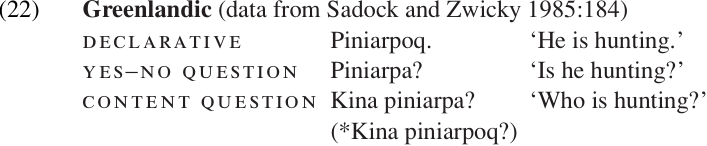
In some languages, devices which are used to mark Yes–No questions particles, interrogative mood affixation, special intonation, etc.–also occur (either optionally or obligatorily) in content questions. For example, the interrogative mood is obligatory in Greenlandic in both Yes–No questions and content questions (22). But these features are of secondary importance in content questions. The crucial defining feature of a content question is the presence of an interrogative (Wh-) word.
1. More precisely, in focus position. In many languages this means sentence-initial. But in languages like Hungarian, in which focused elements occupy a non-initial position, the question word will appear there as well.
2. This name is inherited from the Transformational Grammar analysis of these constructions. Under the approach adopted here, we assume that these structures are directly generated by special PS rules. See Kroeger (2004) and references cited there.








