Compound sentences
A sentence can contain more than one sentence within it, for example:
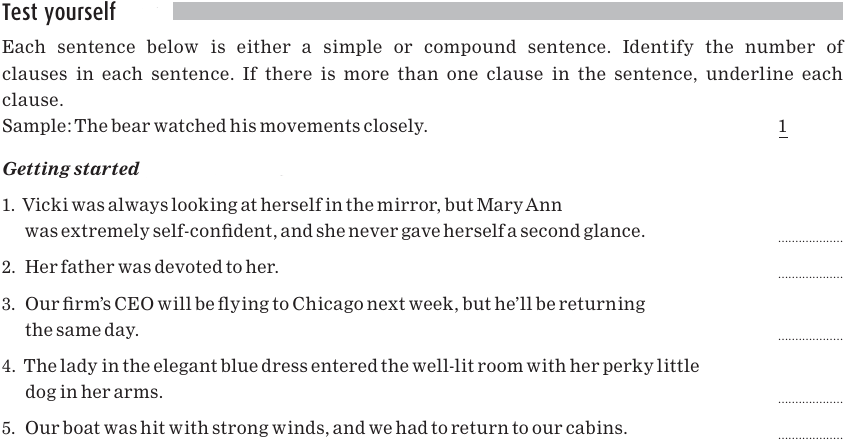
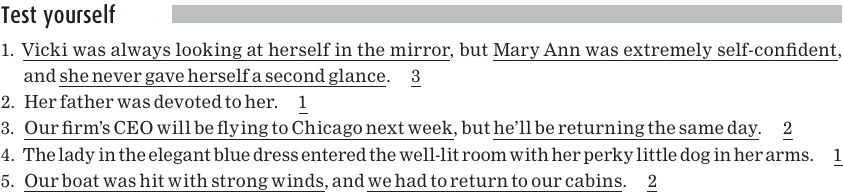
1. Jane put the glass vase on the table and her mother picked it up.
This is an example of a compound sentence. It actually contains two sentences. The first is: Jane put the glass vase on the table. The second is: Her mother picked it up. Since a sentence within a sentence is called a clause, we can also say that sentence 1 contains two clauses. Just as a simple sentence must contain at least a subject and a verb phrase, each of the sentences (clauses) within a compound sentence must contain its own subject and verb phrase.
Conjunctions, like and, or, and but, join things. In fact, the two sentences within sentence 1 are joined by the conjunction and. Recall also that there are two kinds of conjunctions, coordinating and subordinating. The sentences in a compound sentence are joined together by a coordinating conjunction. As we discussed that there are three common coordinating conjunctions; they are and, or, and but. Four less common ones are for, so, yet, and nor. (Remember FANBOYS, which contains the first letter of each.)
Quick tip
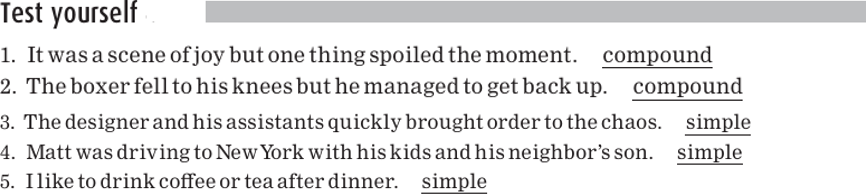
A sentence that is made up of two or more sentences (clauses) joined by a coordinating conjunction (most commonly and, or, and but) is called a compound sentence.
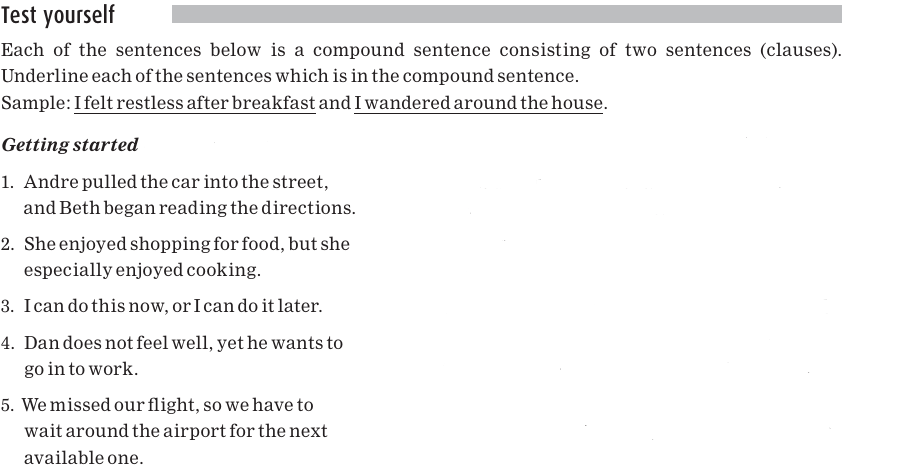
Answers

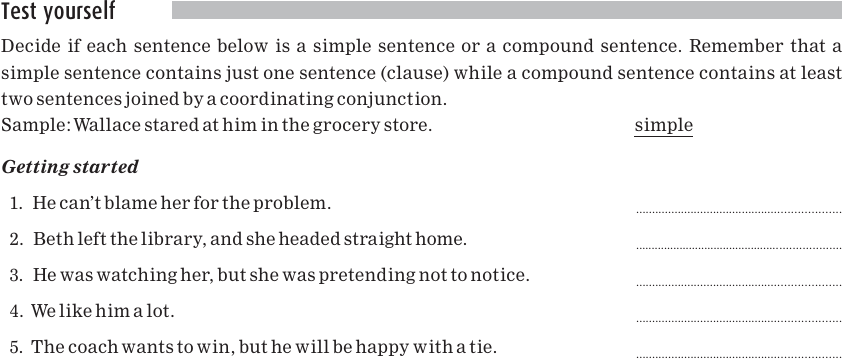
Answers
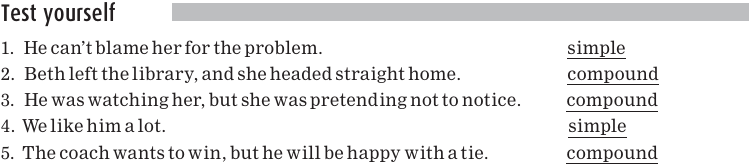
A compound sentence can contain more than two sentences:
2. Nora was Zach’s stepmother but she treated him like her other children and he trusted her completely.
Here, the three sentences that make up this sentence are: (1) Nora was Zach’s step mother; (2) she treated him like her other children; (3) he trusted her completely. So, the sentence There was a glass vase on the table and Jane picked it up contains two sentences, or clauses. The sentence Nora was Zach’s stepmother but she treated him like her other children and he trusted her completely contains three sentences, or clauses. In fact, a compound sentence can contain any number of sentences, though we usually limit ourselves to just a few:
3. He turned his head away and he pretended to ignore her but he continued
to listen to her and in fact he hung on her every word. (4 sentences or clauses)
keep in mind that you can’t tell if a sentence is simple or compound by how long it is; you need to see if it contains one or more than one complete sentence within it. For example, the following sentence, although it is long, is just a simple sentence:
4. The tall man with the violin case quickly climbed the stairs to the abandoned warehouse near the rail road tracks.
This is a simple sentence because it has just one subject, the tall man with the violin case, and one verb phrase - notice that there is just one verb, climbed. (The sentence is just long because it contains a few preposition phrases.) And the following sentence, although it is short, is a compound sentence: John laughed and Mary cried. It’s a compound sentence because it contains two sentences that can stand alone: John laughed; Mary cried. Each of these has its own subject and verb phrase.
Answers
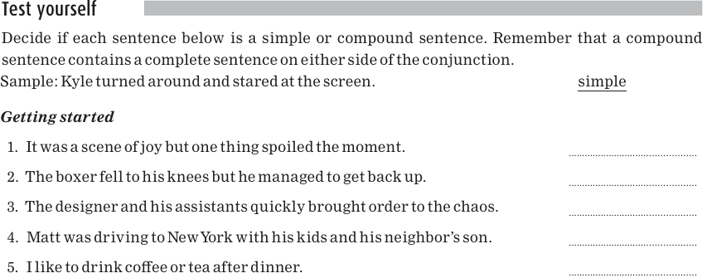
Keep in mind that a compound phrase is not the same thing as a compound sentence. For example, the following sentence has a compound noun phrase (underlined):
5. The teacher graded the students’ exams and their papers.
We’ve certainly got a coordinating conjunction, and, in sentence 5. However, the question is, what is the and joining? If we look at what’s on each side of the and, we find the following: The teacher graded the students’ exams, which is a sentence, and their papers; their papers is not a sentence by itself. In this case, the conjunction and is joining two noun phrases: the students’ exams and their papers. It’s not joining two complete sentences, and so the sentence is not a compound sentence but is a simple sentence.
Answers