RELATED SENTENCES
Looking at related sentences
One interesting characteristic of language is that sentences can be related, in a consistent way, to other sentences. What do we mean by this? Let’s start by looking at some related sentences which we’ve seen before.
1a. She looked up the answer.
1b. She looked the answer up.
2a. We will just drop off the files.
2b. We will just drop the files off.
3a. The professor pointed out the correct answer.
3b. The professor pointed the correct answer out.
You can see that one member of each pair is related to the other in a systematic way: the verb and its particle (both underlined) can either be next to each other or the particle can be on the other side of the next noun phrase. The important point here is that we can’t change the structure of a sentence in any random way. For example, we can’t say *She up looked the answer.
Let’s look at other examples of related sentences:
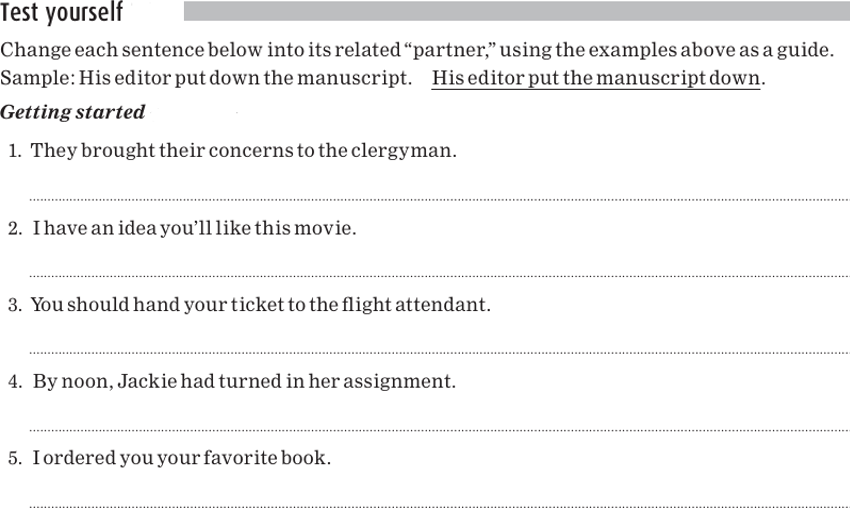
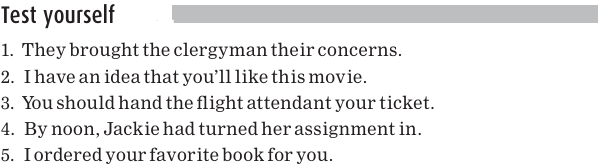
4a. Mary gave the information to Robert.
4b. Mary gave Robert the information.
5a. She told the truth to her granddaughter.
5b. She told her granddaughter the truth.
6a. They bought a car for their teenage daughter.
6b. They bought their teenage daughter a car.
Once again, you can see that these indirect object pairs are related to each other in a systematic way. And again, we can’t just randomly change them; for example, we can’t say, *Mary Robert the information gave.
Here’s one more example of related sentences:
7a. I know that you’re right.
7b. I know you’re right.
8a. You believed that the defendant was innocent.
8b. You believed the defendant was innocent.
9a. The residents of the village feel that the new high way is important.
9b. The residents of the village feel the new highway is important.
Here, while the word that can be deleted, we can’t delete just anything. For example, we can’t say*I that you’re right.
Answers
So far, the related sentence pairs we’ve looked at have the same meaning. For example, She looked up the answer and She looked the answer up mean exactly the same thing. But sometimes sentences are related to each other in a consistent way, even though their meanings are not the same. For example, here’s a statement:
10a. Amanda is working today.
Can you turn it in to a yes/no question? The related yes/no question is:
10b. Is Amanda working today?
No native speaker of English would make the yes/no question something like, *Working Amanda today is. That’s because there’s a systematic relationship between statements and yes/no questions, even though they don’t have the same meaning.
Try another one:
11a.That boy has eaten an enormous breakfast.
The related yes/no question is:
11b.Has that boy eaten an enormous breakfast?
Here are some more examples:
12a. Hank was laughing.
12b. Was Hank laughing?
13a. That artist had chosen to represent animals in his drawings.
13b. Had that artist chosen to represent animals in his drawings?
14a. You can see the old hotel near the rail road station.
14b. Can you see the old hotel near the rail road station?
Another example of related sentences can be seen when we look at statements and tag questions.
For example, here’s a statement:
15a. Molly should do that.
Can you turn it in to a tag question? The related tag question is:
15b. Molly should do that, shouldn’t she?
No native speaker of English would respond with the tag question, *Mary should do that, can’t they? That’s because, again, there’s a systematic relationship between statements and tag questions, even though they don’t have the same meaning.
Try another one:
16a. The students are waiting to have lunch.
The related tag question is:
16b. The students are waiting to have lunch, aren’t they?
Here are some more examples:
17a. He had mailed the letter yesterday.
17b. He had mailed the letter yesterday, hadn’t he?
18a. Mr. Peters was wearing a hat with a wide brim.
18b. Mr. Peters was wearing a hat with a wide brim, wasn’t he?
19a. Rebecca will wait for her.
19b. Rebecca will wait for her, won’t she?
See Quantifiers for further discussion of yes/no questions and tag questions.
So far, we’ve been looking at sentence types that we’ve already come across later. However, there are many more sentences in English that are related. We’ll take a closer look at two sets of related sentences that we have not discussed before.








