Active and passive sentences
So far, we’ve seen lots of sentences with the following pattern:
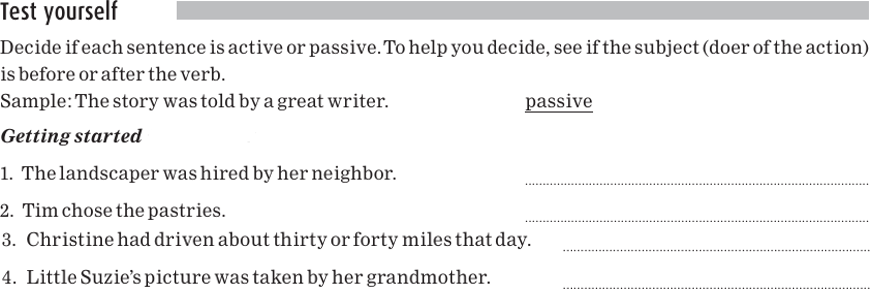
1a. The witch kidnaped Esmeralda.
In this sentence, the witch is the subject (the doer of the action); kidnaped is an action verb, and Esmeralda is the direct object (the receiver of the action). This word order – subject first, then verb, then direct object – is typical of English sentences. Sentences like this, with the subject before its verb, are called active sentences (or are said to be in the active voice).
Quick tip
Sentences with the subject before the verb are called active sentences. Example: Charley repaired this computer.
What do you notice about this next sentence?
1b. Esmeralda was kidnaped by the witch.
It has basically the same meaning as sentence1a, but with a different structure. We can see that the noun phrase the witch is still the subject; however, it no longer occurs before the verb. It occurs after the verb and following the word by. The direct object noun phrase, Esmeralda, is now before the verb. Sentences with this pattern are called passive sentences (or are said to be in the passive voice).
Quick tip
Sentences which do not have the subject before the verb are called passive sentences. Example: This computer was repaired by Charley.
Here are some more examples of active and passive sentence pairs:
2a. My friend mentioned his excellent reputation. (active)
2b. His excellent reputation was mentioned by my friend. (passive)
3a. Nellie sent the Browns a present. (active)
3b. The Browns were sent a present by Nellie. (passive)
4a. The bird ate the worm. (active)
4b. The worm was eaten by the bird. (passive)
Answers
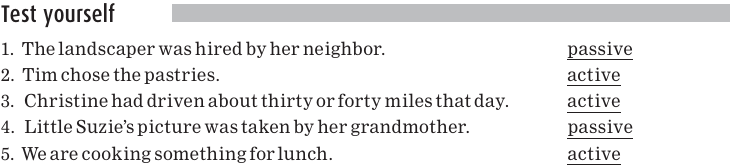
In order for an active sentence to have a related passive sentence, it must have a direct object. Unlike the sentences we have looked at so far, the following sentences do not have a direct object; therefore, they don’t have related passive sentences.
5. The train arrived late.
6. We are traveling to Mexico.
7. Harry studied.
Active and passive sentences are related to each other in a systematic way. Let’s look more closely at this relationship by examining sentences 8a and 8b.
8a. The policeman saw the criminals. (active)
8b. The criminals were seen by the policeman. (passive)
We will see that there are five ways in which passive sentences like 8b differ from active sentences like8a. We’ll now discuss each of the characteristics of passive sentences.
First, as we mentioned in the last Quick tip, the subject (doer of the action) follows the verb:
8b. The criminals were seen by the policeman.
Second, the word by precedes the subject:
8b. The criminals were seen by the policeman.
Third, the noun phrase that follows the verb in the active sentence occurs before the verb in the passive sentence:
8b. The criminals were seen by the policeman.
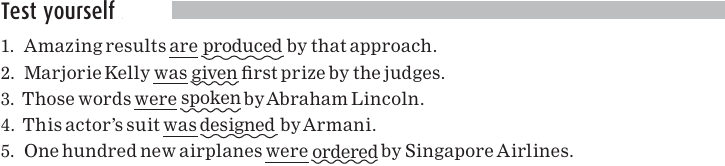
Fourth, passive sentences have a form of be (am, is, are, was, were, be, being) before the verb:
8b. The criminals were seen by the policeman.
We talked about auxiliary, or helping, verbs; the passive be is also a kind of helping verb.
And fifth, the main verb following the passive be is in a special form:
8b. The criminals were seen by the policeman.
You may recognize this special form of the verb as the past participle form of the verb, the same form of the verb that follows the helping verb have. That is, just as each of the other helping verbs has an effect on the verb following it, the passive be also has an effect on the verb following it: the verb must be in its past participle form.
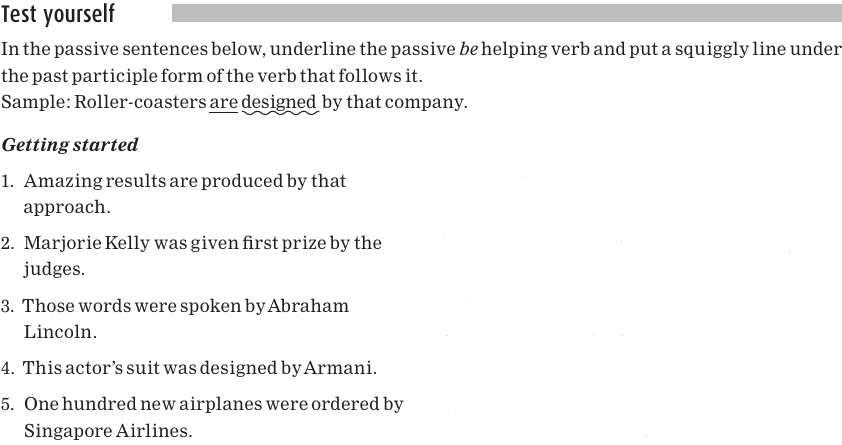
Use the following exercises to help you focus in on the differences between active and passive sentences.
Answers
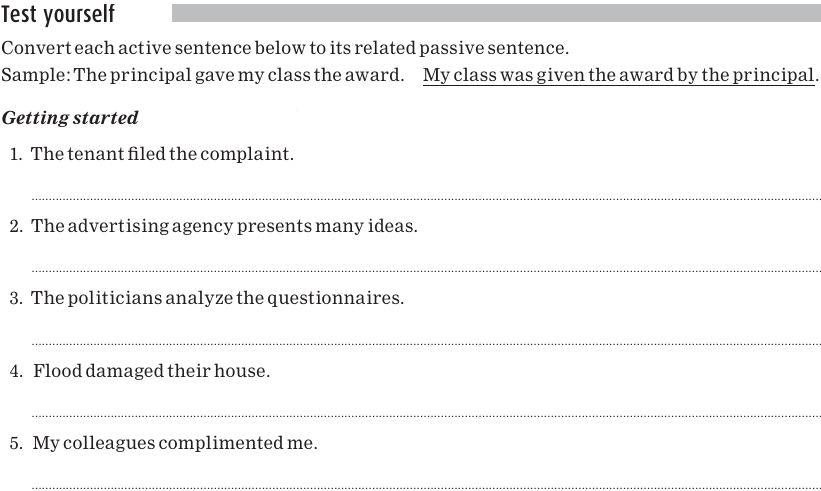
Answers
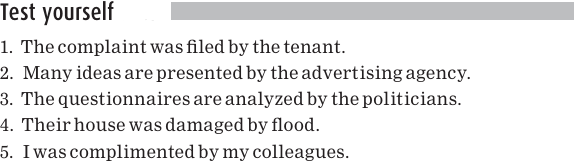
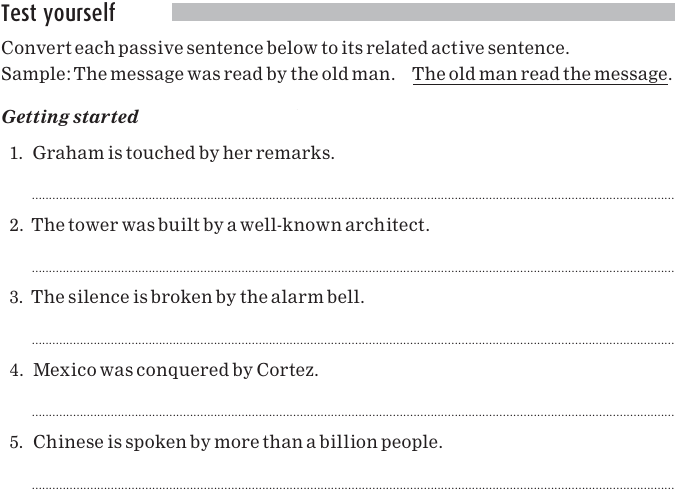
Answers
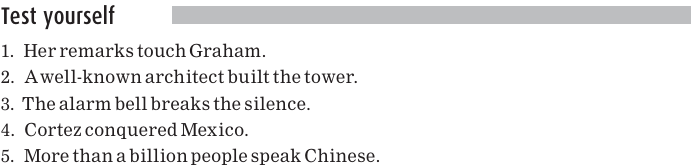
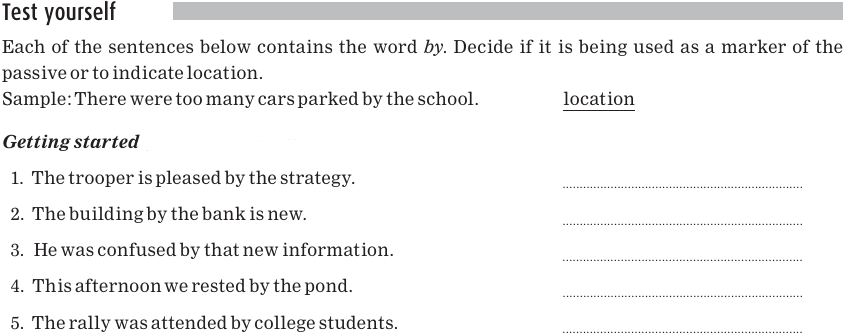
We’ve said that passive sentences contain the word by. Let’s compare by in these next two sentences:
9.The two bags were lost by Dina.
10. She lives by the seashore.
Although both bys are prepositions, their functions are not the same. In sentence 9, by is in a passive sentence, letting us know that the doer of the action (in this case, Dina) is following. But in sentence 10, the seashore is not doing anything; rather, by is telling us about location.
Answers
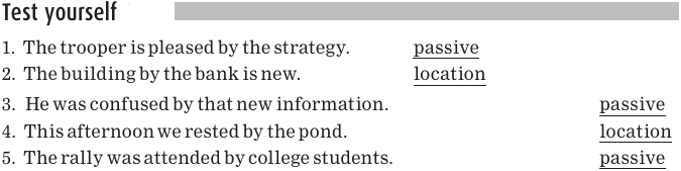
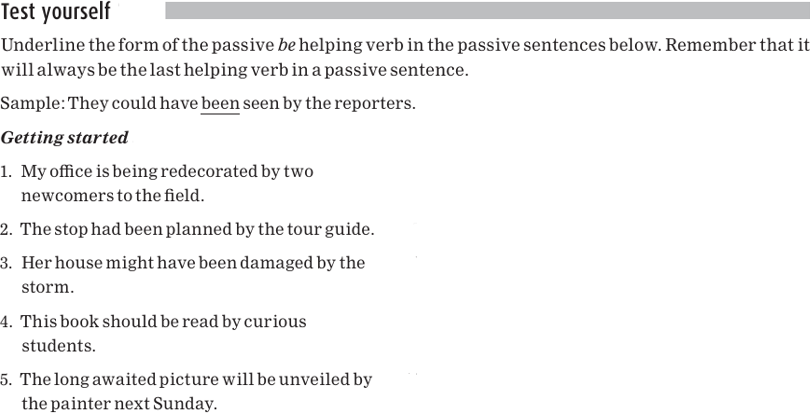
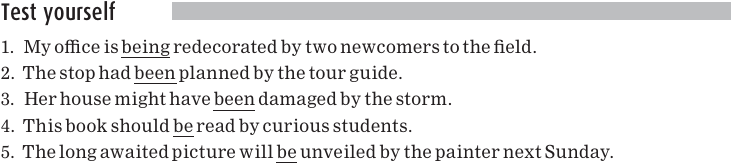
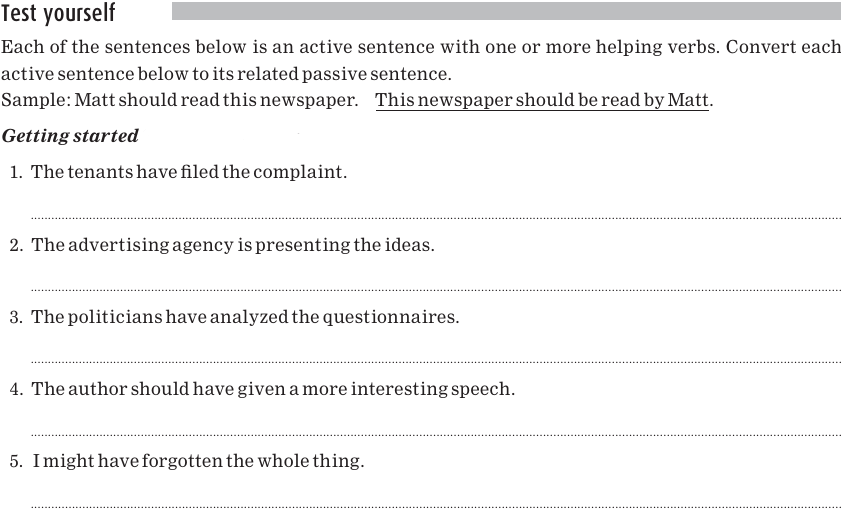
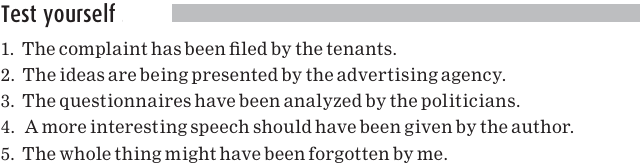
As we mentioned, passive be (in all its forms) is a kind of helping verb, occurring right before the main verb. In a sentence that has other helping verbs as well, the passive be is always the last one. You can see that in the following sentences, where the form of the passive be is underlined and the other helping verbs are in bold:
11.The letter will be answered by McCarthy.
12.The letter has been answered by McCarthy.
13.The letter is being answered by McCarthy.
14.The letter should have been answered by McCarthy.
Quick tip
The passive be helping verb is always placed after all the other helping verbs, right before the main verb. Example: The table has been set by the waitress.
Answers
Answers
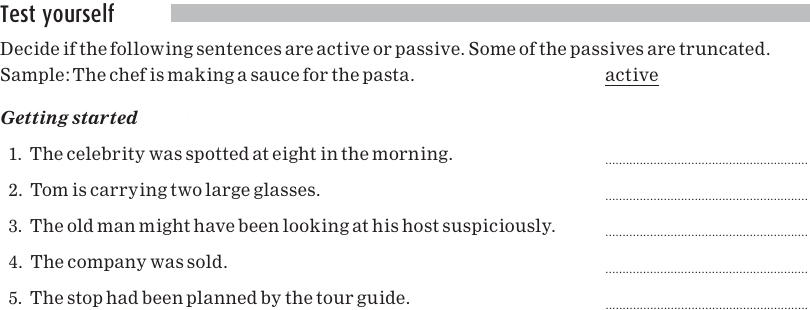
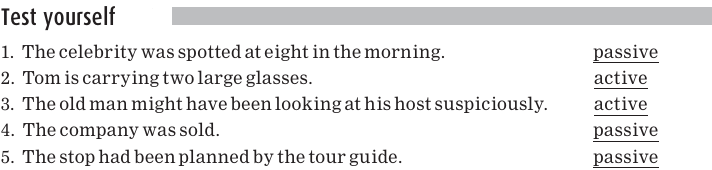
The following sentences are also passive sentences, but they’re different from the ones we’ve talked about so far.
15.The bank was robbed.
16. A landscaper was hired at last.
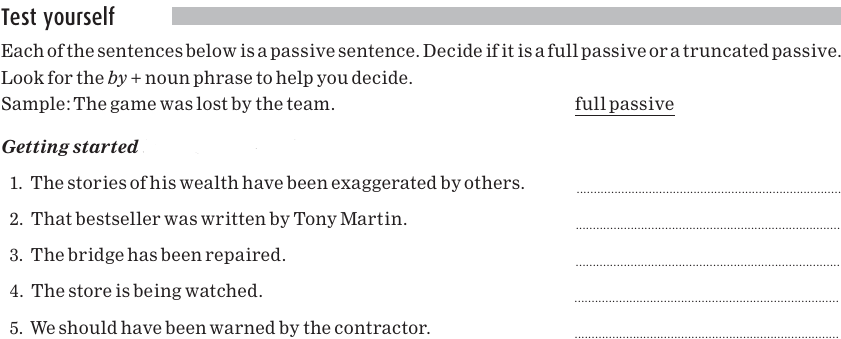
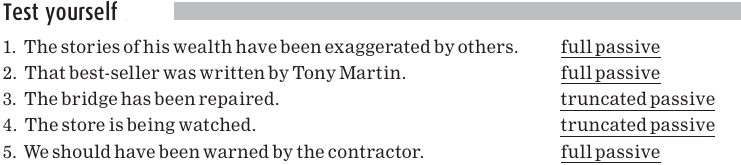
In these passive sentences, the by and the subject are missing. That is, instead of saying The bank was robbed by someone, we have the option of simply saying The bank was robbed, if we don’t feel it’s necessary to say by whom. This kind of passive sentence, where the subject noun phrase is missing, is called a truncated passive. Here are some more examples:
17.My dinner was prepared quickly.
18.That proposal has already been discussed.
Quick tip
A truncated passive is a passive sentence without the by and subject noun phrase. Example:
The proposal was discussed.
Answers
Answers
To enhance your understanding
Let’s compare another active/passive pair of sentences:
19a. Their aunt visits the children every Christmas.
19b. The children are visited by their aunt every Christmas.
In sentence19a, why is the verb visits rather than visit? Since their aunt is one person, we say visits. If there were more than one aunt, we’d say: Their aunts visit the children every Christmas. So in an active sentence, the first noun phrase, the subject, controls the form of the verb.
What happens when the direct object of the sentence, the children, is before the verb, as in the passive sentence19b? You can see that the first noun phrase, the children, is now controlling the form of the verb: we say, the children are visited by their aunt every Christmas (because there is more than one child). Even though there’s still only one aunt, aunt is no longer controlling the form of the verb. The important thing to keep in mind is that in a sentence it is always the noun phrase before the verb, whether or not it’s doing the action, that controls the form of the verb.








