Basic word order
Variations in word order are often used to make one part of the sentence more prominent than another. Even in a language like English, which has fairly rigid word order, the elements of a sentence can be rearranged in various ways to produce different shades of meaning. Compare the effect of the “basic” word order in sentence (4a) with the “marked” orders in sentences (4b–d):

All four of these sentences contain the same propositional meaning; that is, they all describe the same basic event and would be true under the same circumstances. However, they would not normally be spoken in the same contexts or for the same purposes. Sentence (4d) seems to assume that we already know that SOMETHING was given to Mr. Spock; the question is WHAT? The crucial piece of new information provided by this sentence (i.e. the FOCUS of the sentence) is the Klingon dictionary. Sentences (4b, c) also assign special prominence to the Klingon dictionary, this time as TOPIC (what the sentence is about). The act of giving in these sentences is new information, and not presupposed as in (4d). Sentence (4a), which follows the basic, normal, rules of English word order, does not assign special prominence to any particular constituent; it simply describes the event in a relatively “neutral” way.
As these examples illustrate, special (or marked) word order is often used to indicate special pragmatic functions such as topic or focus.1 But we cannot recognize marked word orders unless we know the “unmarked,” or basic, word order. In a language like English, it is not too difficult to determine the basic order, at least with regard to the major constituents of the clause (SVO, followed by oblique arguments and complement clauses). But many other languages allow much more freedom of word order than English. How, then, can we decide which of the possible orders for a particular sentence type is the most basic? Bickford (1998:214–216) suggests the following criteria:2
a frequency: the basic order is usually the one that is used most frequently in discourse.
b neutral semantics and pragmatics: basic sentences are normally indicative (statements, not questions or commands) and positive (not negated); and they do not assign special (marked) pragmatic prominence to any constituent. In most theories of grammar, active sentences are also assumed to be more basic than passive.
c avoid pronouns: pronouns often have special word-order properties, so basic word order should be based on the order of full NP and PP arguments.
d subordinate clauses take priority: in many languages, main clauses allow greater variation in word order than do subordinate clauses; thus, the order observed in subordinate clauses is more likely to be the basic order.
e distribution: marked sentence types tend to be appropriate only in certain specific contexts. Neutral word order is generally the order that has the widest distribution, i.e. which can occur in the greatest number of different contexts.
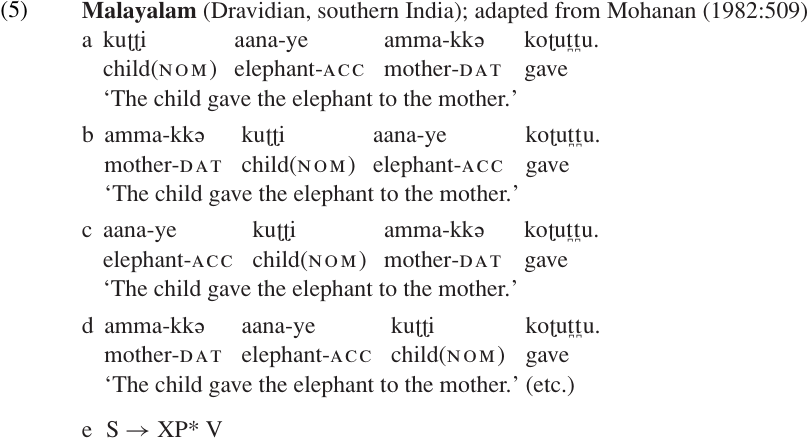
In some languages, however, it may not be possible to determine a “basic” word order. Mohanan (1982) states that in Malayalam any permutation of the constituents in a clause is allowed, as illustrated in (5), provided that the verb occurs in final position. Further, these variations in word order make no significant difference in the semantics or intonation of the sentence. Mohanan argues that Malayalam clause structure is best described by the PS rule in (5e), which says that a clause consists of an arbitrary number of phrasal constituents followed by the verb. In this language, word order is so free that there seems to be little point in identifying one particular order as being more basic than the others.
1. For a more detailed discussion of these pragmatic functions, see Kroeger (2004), Noun Phrases.
2. Criteria (a–d) are from Bickford; (e) is derived from other work on markedness.








