Negation
We will briefly discuss the most common ways in which negative sentences may be formed. To begin with, we need to be able to distinguish negative sentences from positive sentences.
We noted that English tag questions normally have the opposite polarity from the main clause: negative if the main clause is positive; and positive if the main clause is negative. Klima (1964) points out that this pattern provides a test which we can use to distinguish positive from negative sentences in English: if the sentence takes a negative tag, it is probably positive, and vice versa. What does this test tell us about the main clause in each of the following examples?
(36) a Arthur is not happy, is he?
b Arthur is unhappy, isn’t he?
(37) a Bill doesn’t like sushi, does he?
b Bill dislikes sushi, doesn’t he?
Sentences (36a) and (36b) are nearly synonymous– they mean almost the same thing– but the polarity of their tag questions is different. According to the test suggested above, the main clause in (36a) is a negative sentence, while main clause in (36b) is a positive sentence even though it contains a negative word(unhappy).Similarly,(37a) and (37b) are nearly synonymous but differ in polarity: the main clause in (37a) is a negative sentence, while the main clause in (37b) is a positive sentence which contains a negative word (dislikes). These examples illustrate the difference between sentence negation, as in (36a) and (37a), vs. lexical or morphological negation, as in (36b) and (37b). We will discuss the morphological function of affixes like un- and dis-. We will focus on sentence negation.
Klima suggests two other tests that can be used to identify negative sentences in English: only negative sentences can be continued with neither or not even. These tests are illustrated in (38–39). Note that they lead to the same conclusions as the tag question test in (36–37):
(38) a Arthur is not happy, and neither is Peggy.
b Arthur is unhappy, and so/*neither is Peggy.
(39) a Bill doesn’t like coffee, not even with sugar.
b Bill dislikes coffee, (*not) even with sugar.
Of course, these tests are specific to English, and will not work in the same way in many other languages. But it is important to find some grammatical criteria for identifying negative sentences in each language we study.
As the preceding examples illustrate, we cannot assume that every sentence which contains some semantic component of negation is syntactically negative.
The negative sentences in (36a–39a) illustrate the primary strategy for marking clausal negation in English: the free word not and its reduced or contracted form–n’t. Payne (1985) notes that there are several other ways of forming negative sentences, including negated quantifiers (40a), inherently negative quantifiers (40b), and inherently negative adverbs (40c).
(40) a Not many Americans like durian, do they?
b Nobody wears bell-bottoms anymore, do they?
c Bill rarely eats sushi, and neither does Arthur.
Payne (1985) suggests that the primary marker for clausal negation in any particular language can be identified by using weather predicates which take no arguments, e.g. It is not raining. Sentences of this type may be very useful because they are unlikely to contain quantifiers or negative adverbs, and are also unlikely to involve derivational negation (e.g. un- and dis-). However, we should remember that some languages use more than one strategy for marking clausal negation. For example, Malay uses the negative element tidak when the predicate is a verb (41a) or adjective (41b), and bukan when the predicate is an NP (41c) or PP (41d). In addition, there are special negative forms for existential clauses (tiada, 41e) and imperative clauses (jangan, 41f).11
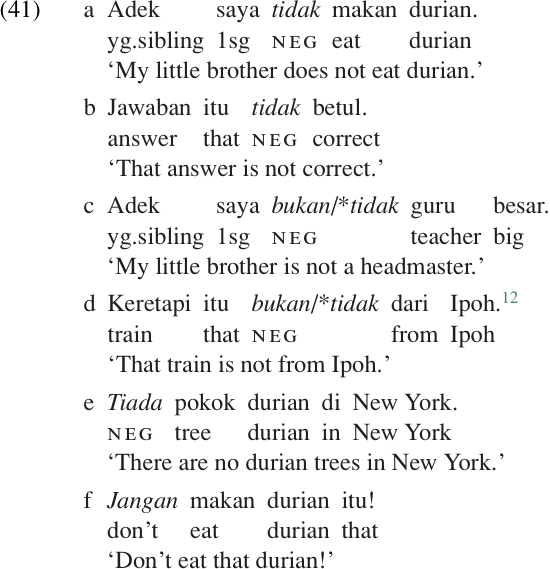
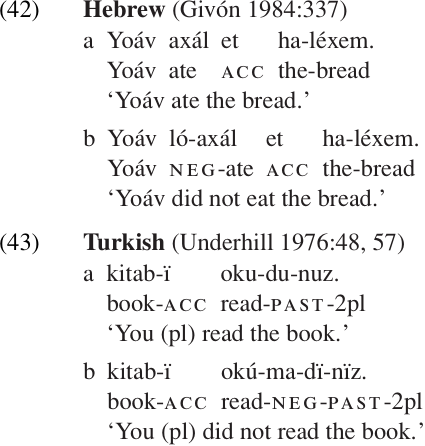
These negative markers in Malay are all independent word forms, as is the English not.13 This use of a free word or particle to express clausal negation is a very common pattern. In many other languages, however, negation is indicated by an affix on the verb.14 Some examples are given in (42–43).
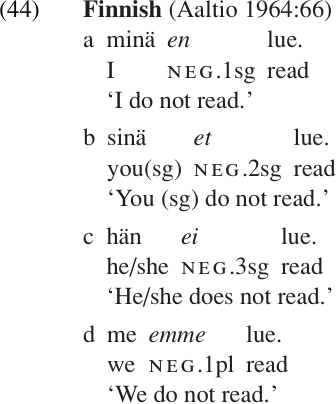
In a smaller number of languages, clausal negation is marked by a special negative auxiliary verb. In Finnish, for example, the negative auxiliary must agree with the person and number of the subject, as illustrated in (44).
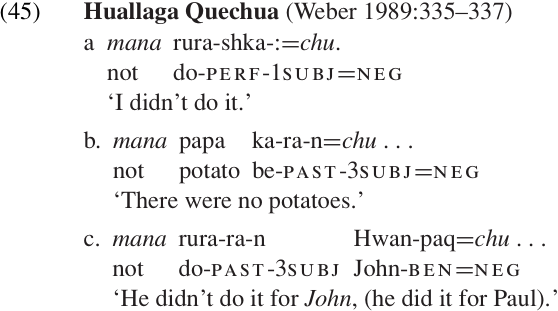
Finally, it is not uncommon to find negation indicated by a pair of markers. In Quechua, for example, the most common pattern of clausal negation involves the free form mana ‘not’ plus a clitic particle =chu ‘NEG.’ The particle =chu may occur on the main verb, as in (45a, b), or may attach to the focused element as in (45c).
What all of these strategies have in common is that, in order to form a negative sentence, something must be added to a basic positive clause. This is one of the reasons that we consider the positive clause to be more “basic” than the corresponding negative clause.
11. Bukan is also used to negate the truth of an entire proposition. Several other languages which have a special negative existential predicate were listed in Non-verbal predicates (31).
12. Nik Safiah et al. (1986).
13. The word not is sometimes referred to as an “adverb,” but does not really fit naturally into any lexical category.
14. (42–43) involve inflectional negation, as opposed to the derivational negation in words like unhappy and dislike. See Derivational morphology for a discussion of the difference.








