

Grammar


Tenses


Present

Present Simple

Present Continuous

Present Perfect

Present Perfect Continuous


Past

Past Simple

Past Continuous

Past Perfect

Past Perfect Continuous


Future

Future Simple

Future Continuous

Future Perfect

Future Perfect Continuous


Parts Of Speech


Nouns

Countable and uncountable nouns

Verbal nouns

Singular and Plural nouns

Proper nouns

Nouns gender

Nouns definition

Concrete nouns

Abstract nouns

Common nouns

Collective nouns

Definition Of Nouns

Animate and Inanimate nouns

Nouns


Verbs

Stative and dynamic verbs

Finite and nonfinite verbs

To be verbs

Transitive and intransitive verbs

Auxiliary verbs

Modal verbs

Regular and irregular verbs

Action verbs

Verbs


Adverbs

Relative adverbs

Interrogative adverbs

Adverbs of time

Adverbs of place

Adverbs of reason

Adverbs of quantity

Adverbs of manner

Adverbs of frequency

Adverbs of affirmation

Adverbs


Adjectives

Quantitative adjective

Proper adjective

Possessive adjective

Numeral adjective

Interrogative adjective

Distributive adjective

Descriptive adjective

Demonstrative adjective


Pronouns

Subject pronoun

Relative pronoun

Reflexive pronoun

Reciprocal pronoun

Possessive pronoun

Personal pronoun

Interrogative pronoun

Indefinite pronoun

Emphatic pronoun

Distributive pronoun

Demonstrative pronoun

Pronouns


Pre Position


Preposition by function

Time preposition

Reason preposition

Possession preposition

Place preposition

Phrases preposition

Origin preposition

Measure preposition

Direction preposition

Contrast preposition

Agent preposition


Preposition by construction

Simple preposition

Phrase preposition

Double preposition

Compound preposition

prepositions


Conjunctions

Subordinating conjunction

Correlative conjunction

Coordinating conjunction

Conjunctive adverbs

conjunctions


Interjections

Express calling interjection

Phrases

Sentences


Grammar Rules

Passive and Active

Preference

Requests and offers

wishes

Be used to

Some and any

Could have done

Describing people

Giving advices

Possession

Comparative and superlative

Giving Reason

Making Suggestions

Apologizing

Forming questions

Since and for

Directions

Obligation

Adverbials

invitation

Articles

Imaginary condition

Zero conditional

First conditional

Second conditional

Third conditional

Reported speech

Demonstratives

Determiners


Linguistics

Phonetics

Phonology

Linguistics fields

Syntax

Morphology

Semantics

pragmatics

History

Writing

Grammar

Phonetics and Phonology

Semiotics


Reading Comprehension

Elementary

Intermediate

Advanced


Teaching Methods

Teaching Strategies

Assessment
Assessing Creativity through Common Consensus Discussion The Delphi survey
المؤلف:
Gipsy Chang & Josephine Csete
المصدر:
Enhancing Teaching and Learning through Assessment
الجزء والصفحة:
P463-C38
2025-08-25
496
Assessing Creativity through Common Consensus Discussion
The Delphi survey
In the stage 1 Delphi survey, participating teaching faculty held different opinions towards the study in the beginning. "This is the first time I look into the creativity of students' films in such a structural way. Interesting!", said one of the teachers who welcomed the idea. However, some were skeptical, "We are professionals. We should be able to tell if a film is creative or not, no need to discuss" commented another colleague.
After the preliminary round, in which panelists were encouraged to spell out their opinions, it was discovered that there were many differences among them in what to assess in student's work. For example, one teacher thought that one essential assessment criterion is communication,
"Film is a form of communication. Therefore, a film should be judged by how well it communicates its message to the audience. If creativity hampers communication, it should be taken out."
He weighted communication over creativity. However, others did not share his opinion and discussion through emails was opened in an anonymous way with me acting as the moderator. The results of the two surveys revealed that some colleagues did change their mind and support this argument later while many of them continued to hold their original opinion (increase from 12.5% in the 1st round to 37.5% in the 2nd round).
As shown from Figure 2, higher levels of consensus were reached in the 2nd round survey. For example, only one item reached 100% consensus in the 1st round while in the 2nd round 5 items did. As for items that reached 75% or more, there were 7 in the 1st round but increased to 11 in the subsequent survey.
One significant difference and interesting change over the two surveys is the decrease in the choice of 'no opinion' for items. In the 1st round 4 items received zero responses of neutral as indicated by a "3".
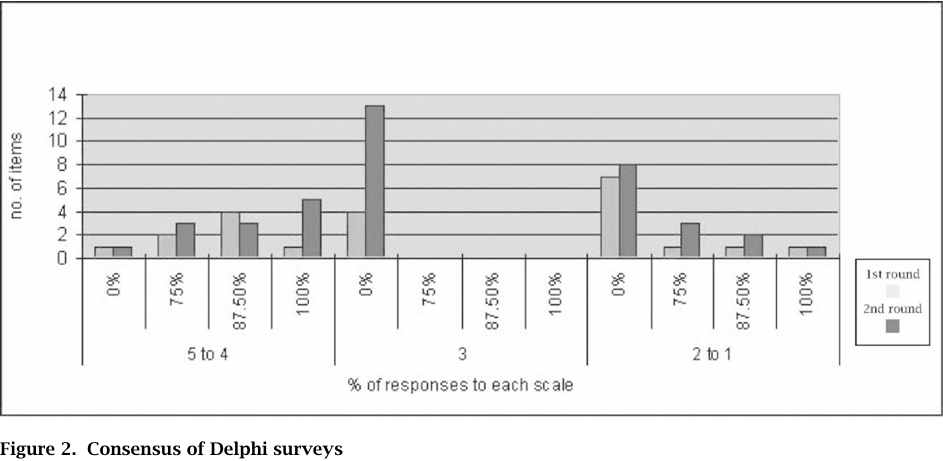
In the second round the number of items receiving no neutral responses moved up to 13 of the possible 25. This indicates that after repeated surveys and sharing of others' ideas in discussion, most panelists made up their mind whether or not they considered certain items important in assessing student's creativity. The Delphi method may be considered for other complicated issues, not just to establish consensus but also to provide a mechanism for people concerned to clarify their thoughts.
الاكثر قراءة في Assessment
اخر الاخبار
اخبار العتبة العباسية المقدسة
الآخبار الصحية

قسم الشؤون الفكرية يصدر كتاباً يوثق تاريخ السدانة في العتبة العباسية المقدسة
"المهمة".. إصدار قصصي يوثّق القصص الفائزة في مسابقة فتوى الدفاع المقدسة للقصة القصيرة
(نوافذ).. إصدار أدبي يوثق القصص الفائزة في مسابقة الإمام العسكري (عليه السلام)


