The standards model of assessment
The essence of the standards model is captured in the following:
If students are to learn intended outcomes in a reasonably effective manner, then the teacher's fundamental task is to get students to engage in learning activities that are likely to result in their achieving those outcomes. (Shuell, 1986: 429)
Here, it is necessary:
1. to describe desired or rather intended outcomes in the form of standards or criteria that students are to attain.
2. to engage students in learning activities that are likely to bring about the intended outcomes.
3. to judge if and how well students’ performances meet the criteria.
The key is in translating syllabus topics into intended learning outcomes (ILOs). The difference is important. A syllabus topic is a direction to the teacher to teach the content specified; an ILO is a direction to the students informing them how they are expected to change as a result of learning that topic. Gardner (in Wiske,1993) uses the term ‘performances of understanding’ in the sense that if students really understand something, in the way we mean as educators of professionals, they would act differently towards this aspect of the world, not simply talk about it. Talking about the topic in academic language is only declarative knowledge. While this is one way of expressing what it means to ‘understand’ something, in most courses we teach, particularly in professional education, students need to do more than just talk, they need to demonstrate that they can put their knowledge to work, that they see things differently and behave more effectively in the topic area. This is what I call functioning knowledge (Biggs, 2003). Our ILOs must therefore not require only verbal statements from students, but that they behave appropriately in terms of set criteria or standards of performance.
These criteria need to be ‘authentic’ to the intended outcomes. Paraphrasing what the teacher or the textbook has said is usually not authentic. In teaching psychology to teachers, for example, it is irrelevant to my ILOs if students can repeat in an exam situation the gist of what I told them months earlier. Totally irrelevant! But it is very relevant if they can demonstrate to me that they are making different and better decisions about their teaching as a result of what they have learned in my courses. The intended outcomes are almost always whole performances, not detached components of those performances, and are thus best assessed holistically not analytically, as already discussed.
Procedurally, it helps to express the ILOs of the unit/course in terms of verbs specifying what students should be able to do after teaching. Given we have to award grades, such as Passes or Distinctions, or As, Bs and Cs, criteria need to be specified that allow teachers to judge how well the ILOs have been met: adequately, very well, brilliantly, and what that might mean in terms of the award grade.
Different students may well have different ways of demonstrating this. It is not necessary to insist that all students undertake the same assessment tasks. The assessment task is only a means to an end: to see how well criteria have been met and there may be alternative ways of demonstrating that. In portfolio assessment, the students in effect choose their own assessment tasks.
The backwash from the standards model is very different from that of typical assessment tasks. The criteria tell students what they are expected to be able to do, with the expectation that most or all should be able to do them, the assessment tasks in most cases being directly relevant to the reasons the students had for taking the course. Holistic assessment tells students to focus on the whole task, not just enough of the components to obtain a pass mark. Assessing by the standards model tells students that success is up to them, it doesn’t matter who else is in the class.
The crucial task of defining the ILOs is aided by using the SOLO taxonomy (Biggs & Collis, 1982). ‘SOLO’ stands for Structure of the Observed Learning Outcome. SOLO is a general framework describing the evolution of learning, from learning as a quantitative increase in knowledge, to learning as becoming structured in qualitatively more complex ways. The following stages are distinguished:
1. Pre-structural, where the learning is irrelevant or inappropriate to the task.
2. Unistructural, where one relevant aspect is picked up.
3. Multi-structural, where several relevant aspects are acquired, but they are not seen as connected. They are the bricks without a blueprint for the building.
4. Relational, where the learnings are integrated, so that the case is made, the phenomenon is explained: the bricks become a building.
5. Extended abstract, where the structure learned become transferable to far domains, hypotheses are constructed, alternatives are suggested.
Levels of understanding can be described as verbs in ascending order of cognitive complexity that parallel the SOLO taxonomy; these are embodied in the ILOs and the assessment tasks are designed to require those verbs. High level, extended abstract, involvement is indicated by such verbs as ‘theorize’, ‘hypothesize’, ‘generalize’, ‘reflect’, ‘generate’, and so on. They call for the student to conceptualize at a level extending beyond what has been dealt with in actual teaching. The next level of involvement, relational, is indicated by ‘apply’, ‘integrate’, ‘analyze’, ‘explain’, and the like; they indicate orchestration between facts and theory, action and purpose. ‘Classify’, ‘describe’, ‘list’, indicate a multi-structural level of involvement: the understanding of boundaries, but not of systems. ‘Memorize’, ‘identify’, ‘recognize’ are unistructural: direct, concrete, each sufficient to itself, the level of understanding required for naming.
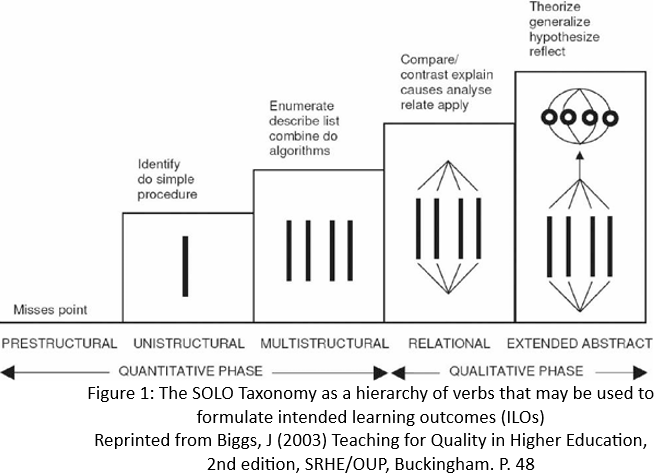
The verbs in the staircase are general, indicating what each family, from lowest to highest, might look like. Particular content areas and topics would have their own specific verbs as well, and the content area of course prescribes the objects those verbs take.








