0
EN
1
المرجع الالكتروني للمعلوماتية

Grammar

Tenses

Present

Present Simple

Present Continuous

Present Perfect

Present Perfect Continuous

Past

Past Simple

Past Continuous

Past Perfect

Past Perfect Continuous

Future

Future Simple

Future Continuous

Future Perfect

Future Perfect Continuous

Parts Of Speech

Nouns

Countable and uncountable nouns

Verbal nouns

Singular and Plural nouns

Proper nouns

Nouns gender

Nouns definition

Concrete nouns

Abstract nouns

Common nouns

Collective nouns

Definition Of Nouns

Animate and Inanimate nouns

Nouns

Verbs

Stative and dynamic verbs

Finite and nonfinite verbs

To be verbs

Transitive and intransitive verbs

Auxiliary verbs

Modal verbs

Regular and irregular verbs

Action verbs

Verbs

Adverbs

Relative adverbs

Interrogative adverbs

Adverbs of time

Adverbs of place

Adverbs of reason

Adverbs of quantity

Adverbs of manner

Adverbs of frequency

Adverbs of affirmation

Adverbs

Adjectives

Quantitative adjective

Proper adjective

Possessive adjective

Numeral adjective

Interrogative adjective

Distributive adjective

Descriptive adjective

Demonstrative adjective

Pronouns

Subject pronoun

Relative pronoun

Reflexive pronoun

Reciprocal pronoun

Possessive pronoun

Personal pronoun

Interrogative pronoun

Indefinite pronoun

Emphatic pronoun

Distributive pronoun

Demonstrative pronoun

Pronouns

Pre Position

Preposition by function

Time preposition

Reason preposition

Possession preposition

Place preposition

Phrases preposition

Origin preposition

Measure preposition

Direction preposition

Contrast preposition

Agent preposition

Preposition by construction

Simple preposition

Phrase preposition

Double preposition

Compound preposition

prepositions

Conjunctions

Subordinating conjunction

Correlative conjunction

Coordinating conjunction

Conjunctive adverbs

conjunctions

Interjections

Express calling interjection

Phrases

Sentences

Clauses

Part of Speech

Grammar Rules

Passive and Active

Preference

Requests and offers

wishes

Be used to

Some and any

Could have done

Describing people

Giving advices

Possession

Comparative and superlative

Giving Reason

Making Suggestions

Apologizing

Forming questions

Since and for

Directions

Obligation

Adverbials

invitation

Articles

Imaginary condition

Zero conditional

First conditional

Second conditional

Third conditional

Reported speech

Demonstratives

Determiners

Direct and Indirect speech

Linguistics

Phonetics

Phonology

Linguistics fields

Syntax

Morphology

Semantics

pragmatics

History

Writing

Grammar

Phonetics and Phonology

Semiotics

Reading Comprehension

Elementary

Intermediate

Advanced

Teaching Methods

Teaching Strategies

Assessment

قم بتسجيل الدخول اولاً لكي يتسنى لك الاعجاب والتعليق.

Further notes on English Phrase Structure

المؤلف:  PAUL R. KROEGER

المصدر:  Analyzing Grammar An Introduction

الجزء والصفحة:  P81-C5

2025-12-20

425

+

-

20

Further notes on English Phrase Structure

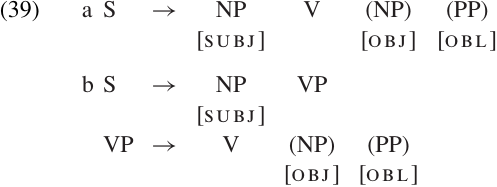
The simple PS rules we have assumed up to now generate only “flat” clause structures, with the verb and all of its complements being immediate daughters of S as shown in (39a). This kind of analysis seems to be correct for many languages, e.g. Malayalam (Mohanan1982). In English, however, and in a number of other languages, there is good reason to believe that the subject NP is not a sister of V. Rather, the verb, its object, and oblique arguments form a constituent labeled VP, and it is this VP which is a sister to the subject NP. The VP analysis for English is shown in (39b).
 

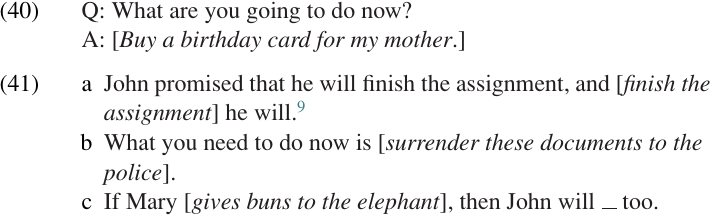
The evidence which supports a VP constituent for English is fairly complex, and we will not consider it in detail here.8 A few of the relevant patterns are illustrated in (40–41). These examples show that the combination of V +OBJ (+ OBL) can function as a sentence fragment in answer to a question (40), and can be re-ordered or deleted as a unit (41). These are some of the classic tests for constituency.
 

Because the VP analysis for English is so widely assumed. However, we will continue to assume a flat clause structure for other languages, because we will not have time to examine the evidence for constituency in each individual language. In general, we prefer to assume the simplest possible structure consistent with the language-specific evidence. With respect to Phrase Structure, this means assuming a flat clause structure unless we find specific evidence supporting a VP constituent in a particular language.


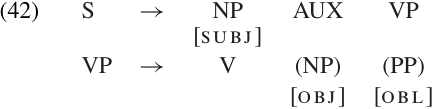
Another question that arises in the analysis of English is the position of the auxiliary verb (AUX). Here the evidence is slightly more ambiguous, and several different analyses have been proposed over the years. Without going into the details of the debate, we will assume that the AUX in English is a daughter of S, a sister to both the VP and the subject NP, as shown in (42).
 

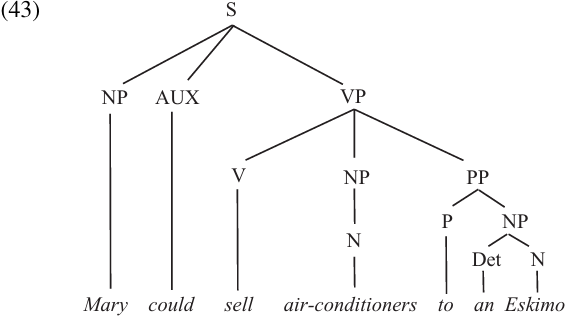
Based on these assumptions, we would assign the structure shown in (43) to a basic clause like Mary could sell air-conditioners to an Eskimo.
 

8. See Radford (1988, Analyzing word structure); and Kroeger (2004, Analyzing word structure) for a discussion of the kinds of evidence which support this claim.


9. From Radford (1988:101).

اخر الاخبار

اشترك بقناتنا على التلجرام ليصلك كل ما هو جديد


