Recursive rules
In the practice exercises, we proposed two simple PS rules for NP and PP, repeated in (25) below. These rules account for the fact that one PP can be embedded within another. In fact, English grammar allows PPs to be nested one inside another for as long as the speaker’s breath holds out; some examples from Constituent structure are repeated in (26).
(25) PP →P NP
NP →Det N (PP)
(26) a a durian on the tree in the garden of that house in Penang
b in the closet at the top of the stairs in that castle beside the river
The tree structure for a portion of example (26a) is presented in (27). This is an example of a RECURSIVE structure: that is, one in which a constituent of a particular category (namely PP) can be embedded inside another constituent of the same category, which, in turn, can be embedded inside another such constituent, etc.
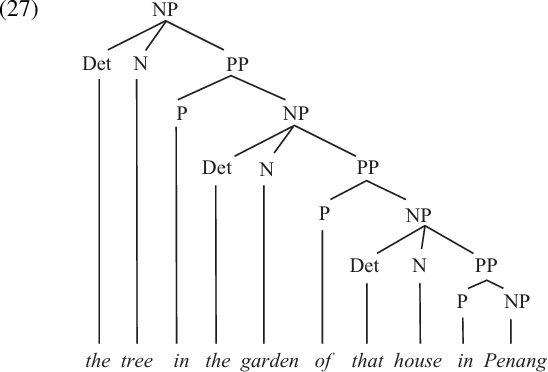
The recursion in (26) is due to the fact that the rule for PP contains an embedded NP, and the rule for NP contains an embedded PP. Now let us consider another kind of recursive structure. Before proceeding further, try to formulate a set of Phrase Structure rules which will generate noun phrases like those in (28).
(28) a [John]’s sister
b [John’s sister]’s husband
c [John’s sister’s husband]’s uncle
d [John’s sister’s husband’s uncle]’s daughter (etc.)
In the simplest case (28a), the NP consists of a possessor phrase (marked with–’s) followed by the head N. But, as the other examples illustrate, the NP may contain any number of possessor phrases.
There are two facts that must be noted about this possessive construction in English before we can arrive at an adequate analysis of its grammatical structure. First, each possessor phrase is a full NP which can contain its own modifiers etc.; it is not just a bare noun as the examples in (28) might suggest.
(29) a [my favorite uncle]’s youngest daughter
b [my favorite uncle’s youngest daughter]’s oldest son
c [my favorite uncle’s youngest daughter’s oldest son]’s best friend
d [my favorite uncle’s youngest daughter’s oldest son’s best friend]’s new bicycle
Second, as noted above, a possessor phrase marked with–’s never co-occurs with a determiner; in fact, the possessor phrase seems to take the place of a determiner.
(30) the old cabin
my old cabin
Abraham Lincoln’s old cabin
∗the my old cabin
∗the Abraham Lincoln’s old cabin
In addition to generating an appropriate Phrase Structure tree for these NPs, we will obviously need to account for the possessive marker–’s itself in some way. Several analyses have been proposed. We will treat the possessive–’s as a kind of genitive case marker, i.e. an element which marks possessive NPs. We will recognize a new Grammatical Relation, POSSESSOR, which is assigned within the NP rather than the clause. Under this approach, our PS rules do not have to mention the possessive marker–’s at all; it will be added morphologically to any NP which bears the POSSESSOR function.1
To summarize, we have said that the possessor phrase is an NP which takes the place of a determiner within another NP, and bears the POSSESSOR function within that NP. These facts are represented in the revised PS rule in (31).

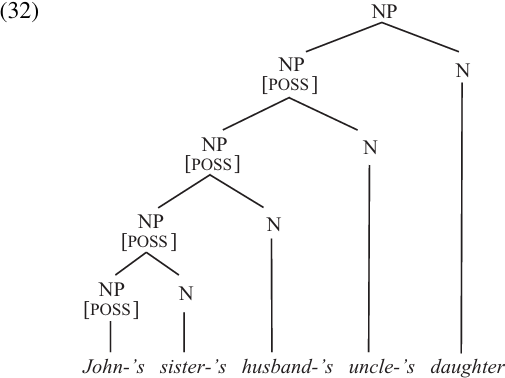
This rule has an interesting property, namely, that the category on the left side of the arrow (NP) also appears on the right side. Any rule that has this property is called a RECURSIVE rule. The rule says that one NP can have another NP (a possessor phrase) embedded inside it; but it also implies that the possessor NP itself can contain a possessor NP, and soon. In this way, the rule in (31) captures another important fact about the genitive construction: there is no set limit to the number of possessor NPs which can be nested one inside the other, as indicated in (28d) and (29d). This rule would assign the structure shown in (32) to the NP in (28d).
English has a second type of possessive construction using the preposition of, as in the father of the bride. The phrase of the bride is a normal PP, and this example could be generated by the rules we have stated in (25). We have already seen that these rules can recursively embed a PP within a PP; the same pattern can occur with possessive PPs, as illustrated in (33):
(33) a friend of a friend of a friend
1. Of course, –’s is not a normal affix but rather a CLITIC, as discussed in Clitics.








