English NP structure (continued)
The structure of the English NP is unusually complex, and we will not try to analyze it in any detail. However, we will use some further examples from English to illustrate a few more general principles about Phrase Structure. Let us begin by considering the distribution of the “pronominal” element one in the following sentences:
(34) a The [dancing fountain] in Kuching is smaller than the one in Singapore.
b The [pretty girl] in the window is my sister, the one on the swing is my cousin.
c The [old car] your brother tried to sell me was a total wreck, but the one my neighbor showed me actually runs.
If we assume that only constituents can be replaced by a pronominal element, the examples in (34) suggest that adjective modifiers form a constituent with the noun that they modify. This constituent is commonly labeled N’ (pronounced “N-bar”). A similar pattern seems to emerge with PP complements:
(35) a The present [King of Bhutan] is more popular than the previous one.
b The president’s public [reaction to the news] was much calmer than his private one.
c This [request for help] is the last one we will consider.
Without trying to account for every detail at this point, these facts suggest that the Phrase Structure rules should look something like (36). A tree diagram showing an NP that could be generated by these rules is given in (37).
(36) NP → Det N’
N’ → (AP) N (PP)
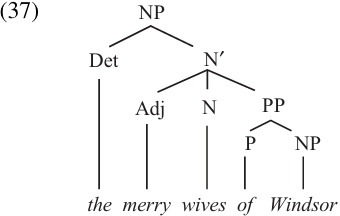
The N’ constituent in these rules may seem like an odd sort of unit. Its head is the same N which is the head of NP; thus we might say that N’ and NP are CONCENTRIC. It is smaller than a complete phrase, but bigger than a single word. Such intermediate-level categories (N’, V’, etc.) have been identified in a number of languages, and some linguists assume they are used in all languages. However, we will use these categories only where there is clear positive evidence for a distinct layer of constituent structure.








