How many tenses?
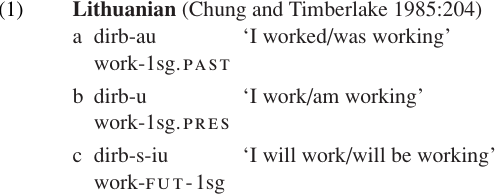
While our words for speaking about time make a three-way distinction between past, present, and future, it is actually somewhat unusual for a language to encode all three of these categories morphologically. One language which does have this property is Lithuanian; note the different verb forms in the following examples:
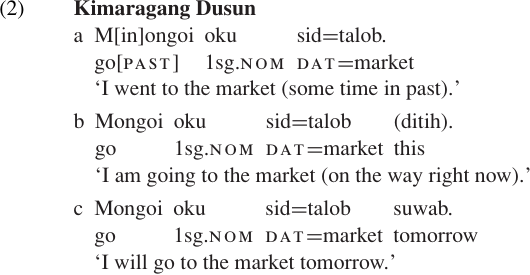
The most common morphological tense systems involve a two-way distinction: either past vs. non-past, or future vs. non-future. We noted above that English has just two morphological tenses, past and non-past. Kimaragang Dusun has a similar system: the infix–in–is used to express actions in the past (2a), but not for actions in the present (2b) or future (2c).1
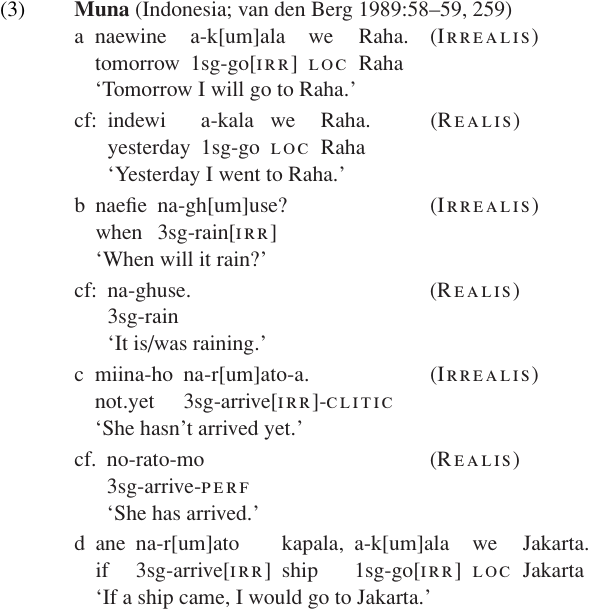
In languages which distinguish future vs. non-future, the future tense form is often used in a next ended sense for unrealized, possible, or potential situations, while the non-future form is used for actual situations. In such systems the future tense form may be called IRREALIS, in contrast to the non-future form which is called REALIS.
The Muna language of Sulawesi, Indonesia, provides a good example. Realis (non-future) tense is unmarked, while irrealis (future) tense is marked by the infix-um-and/ or a change in the form of the subject agreement prefix. Irrealis is used for future events (3a,b); it is obligatory in negated clauses (3c); and it occurs in many conditional clauses (3d).
While tense systems involving two morphological tenses are the most common, a number of languages distinguish more than three tense categories. Let us return briefly to our analogy between tense and spatial location. Spatial deictics in virtually all languages distinguish between things which are near the speaker and things which are far from the speaker (this/that, here/there, etc.). However, many languages allow more than two choices. For example, demonstratives in Portuguese and Dusun distinguish three degrees of distance from speaker (or PROXIMITY).

Similarly, the tense systems of some languages distinguish various degrees of distance in the past or future. The Wishram–Wacso dialect of Chinook has four distinct past tenses:
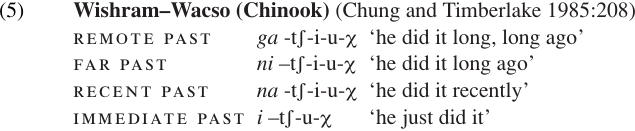
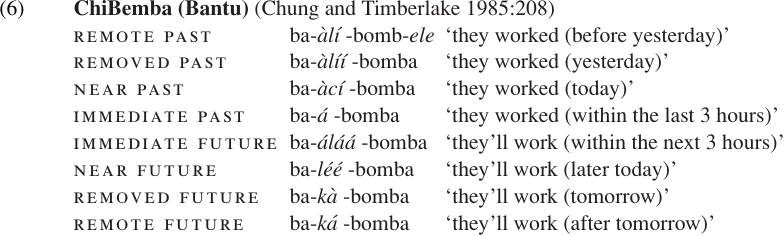
In this language the boundaries between the various categories are rather vague, but recent past is the most likely choice for something which happened in the past week, while far past could be used for events which took place during the past several months at least. Some other languages have very specific cut-off points such as ‘today’ vs. ‘yesterday,’ ‘yesterday’ vs. ‘before yesterday,’ etc. A beautiful example is found in the Bantu language ChiBemba, which has (in addition to the present tense, illustrated in (37) below) a symmetric set of four past and four future tenses.
1. See Non-linear morphology, for a discussion of infixation.








