Task form
The Task web-form is used by students to document the individual tasks contained in the LA; one task form per individual task. Like the LA, the task web-form consists of several sections which are again separated into smaller sections below for ease of explanation. Whereas there is only one instance of a LA, the task web-form was made "clonable" in that students could make as many copies of this form as required.
i. Identification fields
This is similar to the fields for the LA, shown above.
ii. Description of the task
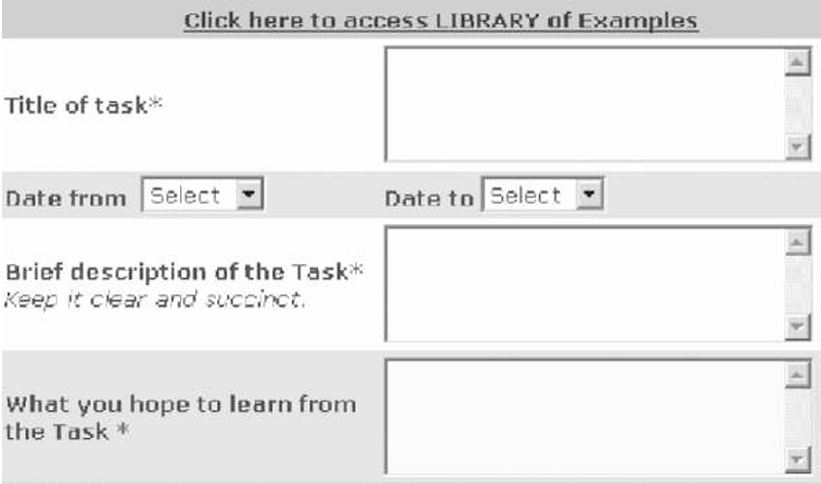
The first main section of the task web-form allows the student to describe the intended task in terms of: a title, period when the task would be performed, a brief description of the task for the layman, and the intended learning outcomes. Context sensitive help and examples available through hyperlinks guide the student through this process.
iii. Transferable skills
There is much discussion concerning the integration of key skills within HE programs (Fallow & Steven, 2000). Making students aware of the transferable skills they use on placement is important as previously these were neither recognized nor valued. This section on the task description web-form provides an extensive table of transferable skills. Only two skills are shown in the screenshot below but the full list includes:
• Communication
• Information technology (IT)
• Application of number
• Working with others
• Improving own learning
• Problem solving
• Professionalism
For each of these skills, a checklist of salient features is provided which students check off as appropriate, as well as a text area where students explain how that skill is involved in the task (not every skill needs to be justified for every task, only those that are appropriate).

iv. Specific skills
The next topic allows the student to document the specific skills required for the task. If the student is involved in a particular laboratory procedure, those skills specific to carrying out that procedure can be mentioned. Again, examples and help are provided through hyperlinks to support web-pages.

v. Supporting evidence
Filling out forms is all very well, but we require the student to provide us with evidence to support the claims s/he is making. The task web-form contains a facility for uploading electronic files which are then 'attached' to the form. When a file is uploaded, a hyperlink to that file appears above the Browse field; clicking that link allows the file to be opened and viewed (if the appropriate program is installed on the computer) or downloaded onto the local computer. Any electronic file can be uploaded, such as: Word, Excel, PowerPoint, or text documents, image, audio and video files, etc. No limit was imposed on the file size but we make students aware that large files take a lot of time to upload or download for viewing and advise them on how to reduce the size of files (particularly files containing scanned images). This facility can be thought of as an 'electronic paperclip'.

The portfolio forms part of the assessment for awarding academic credit at L3. The students, therefore, are required to justify individual tasks at this level. They are assisted in this by the "Criteria for Level 3" section on the web-form. Seven areas are covered (2003):
• Knowledge and understanding
• Ethical issues
• Analysis
• Synthesis
• Evaluation
• Application
• Autonomy in skill use
The screen shot below only shows the first two of these.

For each category, an explanation is provided as well as a text area to be completed by the student explaining how the task is justified. Like the transferable skills section, not every section needs to be completed, only those relevant to that task.
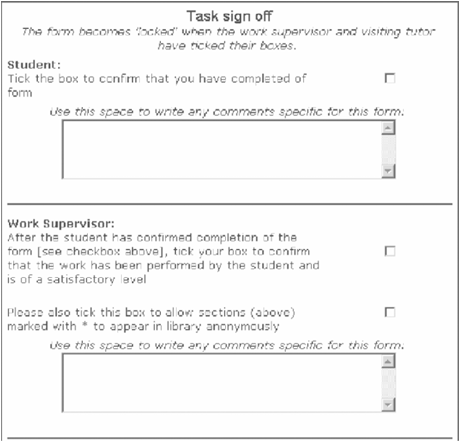
vii. Sign off
This section is similar to that for the LA, except that the work supervisor signs off to confirm that the work has been performed by the student to a standard satisfactory to the needs of the workplace. The VT signs off to confirm that the work has met L3 standard.