Agreement with N
In many languages, certain dependents within a noun phrase are morphologically marked to agree with the number and gender of the head noun. In Portuguese, for example, the list of dependents which must agree with their head N for number and gender includes determiners, modifying adjectives, possessive pronouns, and the numerals ‘one’ and ‘two.’
The examples in (33) involve the nouns menino ‘boy’ and vestido ‘dress,’ which are grammatically masculine, and menina ‘girl’ and galinha ‘hen,’ which are grammatically feminine. As we can see, the form of the demonstrative meaning ‘this’ depends on the gender of the head noun: este for masculine; esta for feminine. Similarly, the adjectives end in–o when the head noun is masculine, and in–a when the head noun is feminine. Moreover, whenever the head noun bears the plural suffix–s, the demonstratives and adjectives are also marked for plural number.
(33) Portuguese NPs (adapted from Healey 1990b, ex. E.2)
a este menino gordo ‘this fat boy’
b esta menina bonita ‘this pretty girl’
c estes meninos gordos ‘these fat boys’
d estas meninas bonitas ‘these pretty girls’
e este vestido bonito ‘this pretty dress’
f esta galinha gorda ‘this fat hen’
g estes vestidos bonitos ‘these pretty dresses’
h estas galinhas gordas ‘these fat hens’
Case is determined by the function of the noun phrase within a clause, and is assigned to the NP as a whole. In many languages, case is marked only once within each NP, e.g. on the head noun, or on a determiner, or with the addition of a separate particle or clitic. In other languages, however, more than one element of the NP may be inflected for case, and when that happens each element must get the same case marking.
Kalkatungu is an example of a language in which determiners and modifiers (including possessor phrases) within an NP must agree with their head Nfor case, as illustrated in (34). Notice that the elements of the possessor phrase in (34c) bear two case markers: genitive marking the function of the possessor NP itself; and ergative indicating the function of the larger NP to which the possessor phrase belongs. This kind of “case stacking” is relatively rare, but does occur in a number of languages.1
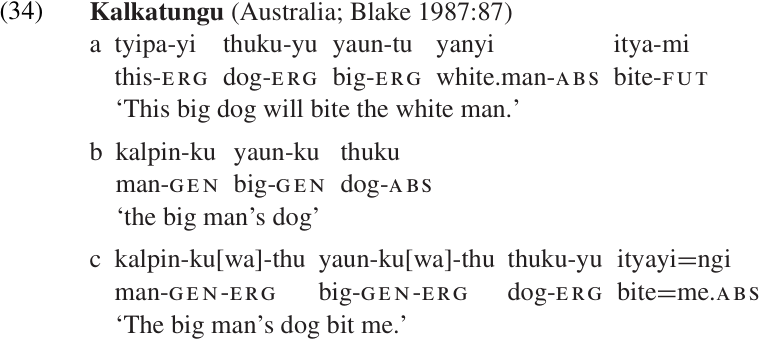
1. Lehmann (1988) cites case agreement like that illustrated in (34), along with other types of evidence, to argue that what we have referred to as “agreement with N” is actually agreement with the NP headed by N; in other words, the modifiers agree with the NP of which they are a part, rather than directly with the head noun that they modify. Case is assigned to the NP as a whole; what is required is that none of the dependents within the NP should have contradictory case features. The same kind of “unification” analysis can be given for number and gender as well.








