Further notes on the predicate complement (XCOMP) relation
We stated that predicate complement phrases must bear a new kind of Grammatical Relation, which we labeled XCOMP. But what evidence do we have that this assumption is actually correct? For example, how do we know that these phrases are really complements and not just adjuncts?
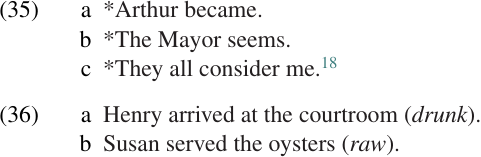
One very important piece of evidence is the fact that predicate complements are often obligatory; compare the examples in (35) with those in (8). Adjuncts are never obligatory, as illustrated by the examples of DEPICTIVE predicate adjuncts in (36). Thus, the fact that the predicate phrases in (7–8) are obligatory provides evidence that they are complements.
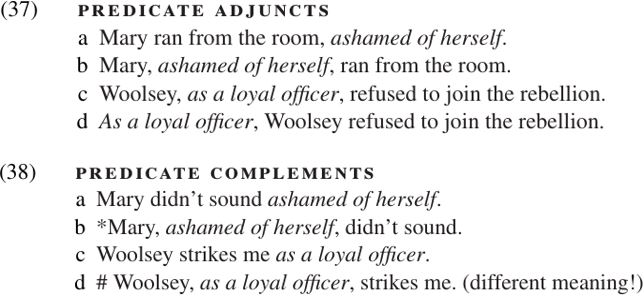
Bresnan (2001:267ff.) presents several other kinds of evidence demonstrating the difference between predicate complements and predicate adjuncts. We will mention two of these briefly. First, adjuncts can often occur in a variety of positions within the sentence, as illustrated in (37); but the position of predicate complements is relatively fixed, as illustrated in (38).
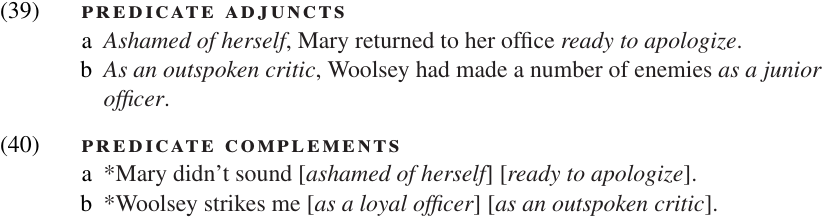
A second difference is that multiple adjuncts may occur within a single clause, as illustrated in (39). Predicate complements, however, like other arguments, must be unique within their clause as illustrated in (40).
Well, then, how do we know that these complement phrases are not, in fact, grammatical objects? At least in the case of post-verbal NPs like those in (7b) and (8a), this might seem like a reasonable hypothesis. (Of course, the fact that APs can occur as predicate complements is itself an important piece of evidence, since an object cannot normally be an AP.) In some languages, e.g. Latin, there is evidence from case marking: direct objects take accusative case, while predicate complement NPs and APs agree with the case marking of the subject (normally nominative).19 Even in English, where case is marked only on personal pronouns, there is a weak difference in case-marking potential between objects and predicate complements, as shown in (41).

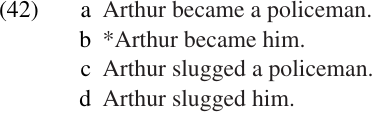
But this difference is rarely observed, since (aside from certain equative clauses like (41a)) personal pronouns are hardly ever used as predicate complements. This restriction on pronouns, which is illustrated in (42), is another piece of evidence for distinguishing predicate complements from objects.
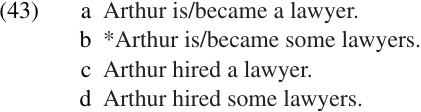
Number agreement proves to be more useful than case marking in English: as (43) shows, predicate complements must agree with the subject NP for number, but there is no such restriction on objects.
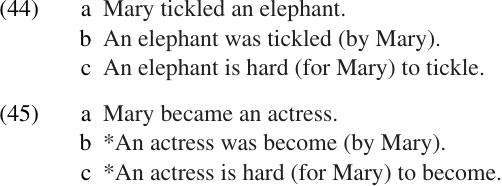
Another kind of evidence comes from the fact that predicate complement NPs cannot appear in certain constructions where direct objects can. For example, an object NP can become the subject of a passive sentence (44b) or of certain adjectives (like hard, easy, etc.) which require a verbal or clausal complement (44c). However, predicate complement NPs never occur in these positions, as illustrated in (45).
Finally, the definite article is often optional in predicate complement NPs, but not in object NPs; this is illustrated in (46). Thus, we have very strong evidence for distinguishing between NPs that function as objects and those that function as predicate complements.

18. Sentence (35c) is grammatical with a different sense of the verb consider, but not with the sense used in (8d).
19. Huddleston (1984:188); Bickford (1998:184).
20. The nominative form she would be used primarily in formal speech styles.








