English: copula plus predicate complement
As noted above, attributive, equative, and locative clauses in English must contain the copula, or linking verb, be. The AP, NP, or PP which follows the copula, as in (7a, b, c, respectively), is called a PREDICATE COMPLEMENT. A traditional definition of this term is “a constituent which is needed to complete the meaning of the predicate.”
(7) a The Mayor is [extremely angry at the press] AP. ATTRIBUTIVE
b Arthur is [a former Governor] NP. EQUATIVE
c His money is [under the mattress] PP. LOCATIVE
We defined a COMPLEMENT as a phrasal dependent which is selected by the head word. The complements of a verb are those elements which are specified in the verb’s subcategorization set. Up to this point, we have discussed complements which bear the Grammatical Relations SUBJ, OBJ, OBJ2, and OBL and generally identify participants. But the phrases that follow the copula in sentences like (7a–c) do not bear any of these relations; they are a different kind of complement. In semantic terms, these complements express predicates, rather than participants; hence the name PREDICATE COMPLEMENT.
The copula is by no means the only verb in English that takes a predicate complement. Some examples of other verbs that require predicate complements are given in (8).
(8) a Arthur became [the Governor of Texas].
b The Mayor seems [extremely angry].
c We elected John [chairman of the board].
d They all consider me [crazy].
We will use the annotation XCOMP to designate the Grammatical Relation of a predicate complement. The “X” stands for any major category (N, A, V, or P), reflecting the fact that predicate complements may be NPs, APs, PPs, or even VPs (though we will not discuss VP complements here). We can represent the structure of an English sentence containing a predicate complement with a rule like (9), where XP stands for any phrasal category (NP, AP, PP, or VP). Notice that this single rule will account for the sentences in (7), which contain a copula, as well as those in (8), which contain other verbs.

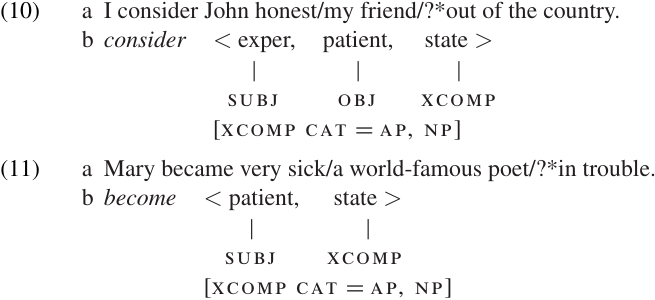
The lexical entries for the verbs in (8), and for the copula, must include a predicate complement as part of the verb’s subcategorization. The problem of specifying the category (NP, AP, or PP) of the predicate complements which can occur with a particular English verb is somewhat complex.1 For simplicity, we will assume that the lexical entry for each verb specifies the possible categories of its XCOMPs. As predicted by the rule in (9), no verb takes more than one predicate complement in the same clause, regardless of category. Possible lexical entries for the verbs consider and become are proposed in (10–11).
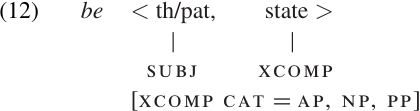
Designing a lexical entry for the copula is somewhat more challenging, largely due to the lack of lexical semantic content.2 However, ignoring this complication for the moment, we can adopt the entry in (12) as a first approximation (example sentences given in (7)).
1. Maling (1983) argues that the restrictions on which type of predicate complement can occur with which verb are actually semantic, rather than categorial. Other writers, however, have argued that some information about categories must be included in the verb’s subcategorization.
2. The subject NPs in (7) should probably not be considered semantic arguments of the copula. Thus, the lexical entry for the copula should probably be similar to that for a Raising predicate; see Kroeger (2004), Lexical entries and well-formed clauses .








