The noun phrase
We now turn to recursion in human languages. As we observed above, recursion in its paradigm manifestations presupposes either noun modification or clause subordination. Whenever either of these is present then there is at least simple recursion. Accordingly, in order to reconstruct the genesis of recursion it suffices to show how noun modification or clause subordination arise.
Within the noun phrase, recursion can be described on the one hand in the form of a taxonomic relation hypernym–hyponym, on the other hand it can—in accordance with (1b)—be represented by means of a formula as in (9), where the category to the left of the arrow is the inclusive taxon and the one to the right of the arrow is the included taxon. Accordingly, whenever there is a rule like (9) there is at least simple recursion, and our concern is with showing how such rules evolve.
(9) N → N [modifier]
As we argued in “Taxonomic concepts”, recursion within the noun phrase is contingent on certain conceptual structures which we referred to as hierarchical taxonomic relations. Each of these relations tends to be associated with specific linguistic encoding structures; Table 6.1 lists the ones that are perhaps, crosslinguistically, most common.
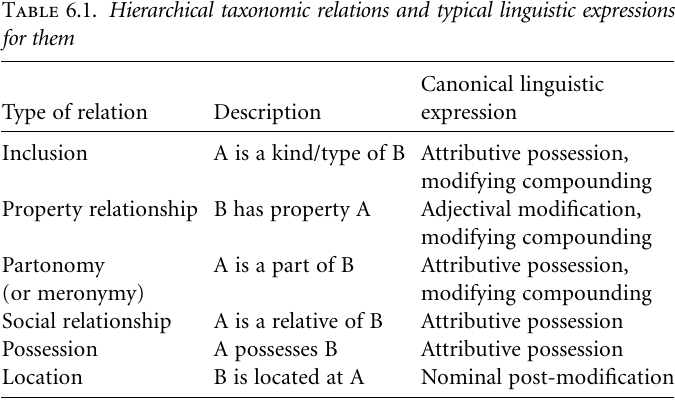
The kinds of linguistic constructions that we will be confined to are attributive possession (or genitive constructions) (“Attributive possession”), modifying compounding (“Modifying compounding”), and adjectival modification (“Adjectival modification”). Finally, there is another common construction conforming to (9), namely relative clauses, which we will return to in “Clause subordination” While there are considerable crosslinguistic differences in the way these relationships are encoded, all languages that we are familiar with have some recursive form of grammatical expressions at least for some of these relationships.








