Basic clause patterns with and without the copula
There is a correlation between the syntactic category of a nonverbal predicate and its semantic function. Clauses like (3a), in which the semantic predicate is expressed by an adjective phrase, generally describe a quality or attribute which is said to be true of the subject. We will (following Payne 1997) refer to examples of this type as ATTRIBUTIVE CLAUSES.
An EQUATIVE CLAUSE is one in which the semantic predicate is expressed by a noun phrase, like (3b). The semantic function of the clause depends on whether the predicate NP is definite or indefinite. If the predicate NP is definite, as in (4a), the equative clause basically states that the two NPs refer to the same individual. If the predicate NP is indefinite, as in (4b,c), the equative clause states that the subject NP is a member of the class named by the predicate NP.
(4) a George Washington was the first President of the United States.
b George Washington was a surveyor.
c George Washington was a tall man.
d George Washington was tall.
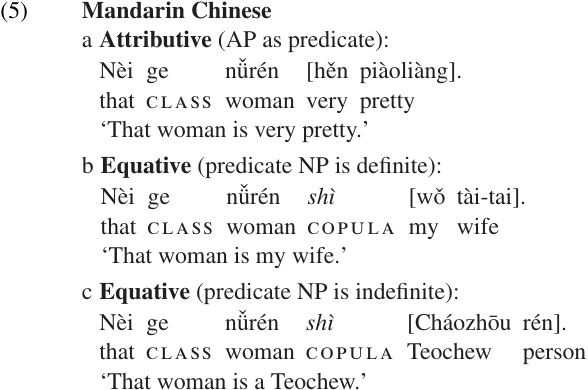
In the latter case, the meaning of the equative clause is very much like that of an attributive clause; compare the equative clause in (4c) with the attributive clause in (4d). But the grammatical structure of an equative clause is normally the same whether the predicate NP is definite or indefinite. In Mandarin Chinese, for example, no copula is used for attributive clauses (those with AP predicates), as illustrated in (5a). However, a copula (linking verb) is used for equative clauses, whether the predicate NP is definite (5b) or indefinite (5c). (The predicate phrase is enclosed in brackets in these examples.)
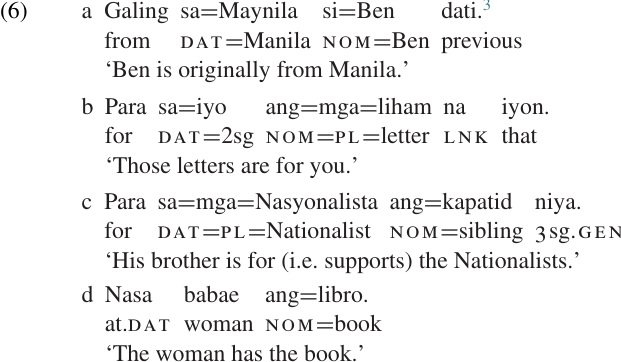
A clause like (3c), in which the semantic predicate is expressed by a prepositional phrase, is often referred to as a LOCATIVE CLAUSE. As this name suggests, clauses of this type are often used to identify the location of the subject, as in (3c). However, this construction can also be used to express a wide range of other semantic functions; some of these are illustrated in the Tagalog examples in (6).
3. (6a) is from Sityar (1989:21).








