Tagalog: verbless clauses
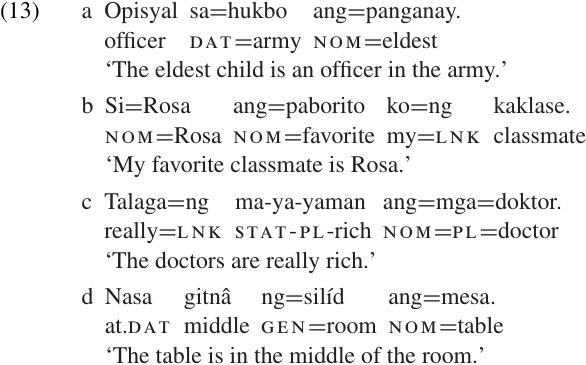
As we saw in (3), attributive, equative, and locative clauses in Tagalog do not contain a copula. Some slightly more complex examples are given in (13). (13a) shows an equative clause with an indefinite predicate NP; (13b) shows an equative clause with a definite predicate NP; (13c) shows an attributive clause with a complex AP as predicate; and (13d) shows a locative clause.1
How shall we represent the structure of these verbless clauses? Some linguists assume that languages like Tagalog employ a “silent” (or invisible) copula, and that the structure of these clauses is essentially the same as the structure of their English translations. However, at least for Tagalog there seems to be no language-internal evidence for this assumption. In fact, there is good evidence that the structure of verbless clauses is very different from the structure of clauses which contain a verb.2 Rather than assuming an invisible copula as the grammatical head of these clauses, it seems preferable (at least for Tagalog) simply to assume that the grammatical head is the NP, AP, or PP which expresses the semantic predicate. This analysis is indicated in the PS rules in (14).
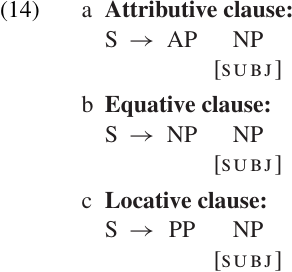
But these rules raise an interesting question. The Coherence condition implies that the complement relations (SUBJ, OBJ, OBJ2, OBL, and now XCOMP) can only occur in a clause when they are subcategorized, i.e. selected by the lexical entry of their predicate. If Tagalog verbless clauses have the structure shown in (14), how are the SUBJ phrases in (3) and (13) subcategorized? Can adjectives, nouns, and prepositions assign the SUBJ relation?
Bresnan (2001) has argued that the answer is “yes,” not just for languages like Tagalog but even for English. She presents a variety of evidence, which we will not discuss here, showing that an XCOMP of any category must assign the SUBJ relation to the phrase of which it is predicated. For example, the XCOMPs in (8a, b) assign the SUBJ relation to the subjects of those sentences, and the XCOMPs in (8c, d) assign the SUBJ relation to the objects of those sentences.3 Bresnan argues that adjectives have argument structures similar to verbs, which include a SUBJ argument; and that nouns and prepositions may optionally acquire argument structures by a regular process of predicate formation.
Without going into the formal details, we will adopt Bresnan’s analysis. Clauses generated by the PS rules in (14) will be well-formed because their non-verbal predicates have argument structures and assign the SUBJ relation.
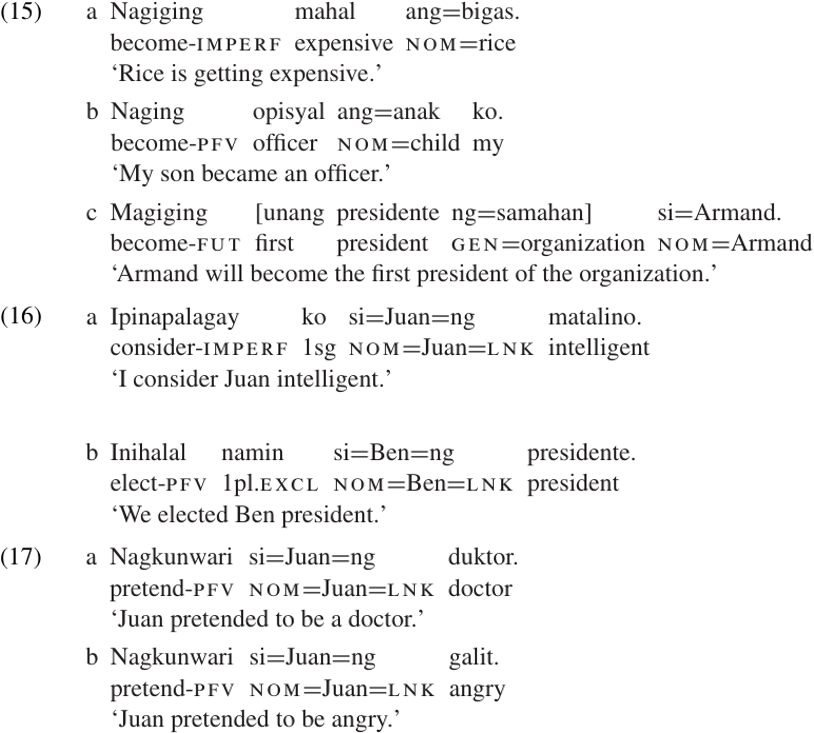
Even languages which have no copula may contain other verbs that require a predicate complement. One such verb in Tagalog is maging ‘become,’ which can take either AP (15a) or NP (15b) complements.4 The verb maging forms a tight constituent with its predicate complement, and is sometimes written as a prefix.5 However, its complement is a full phrasal category and not just a single word, as shown by examples like (15c);soit is (at least in its syntactic properties) a free form, and not an affix. Some other Tagalog verbs which take predicate complements are illustrated in (16–17).
1. The predicate in Tagalog normally occurs as the initial element in its clause, and this is clearly the case in (13a), (13c), and (13d). In (13b), where both NPs are definite, there is some disagreement as to which should be identified as predicate and which as the SUBJ. This construction is sometimes identified as a cleft sentence, and on this analysis the “clefted” NP, i.e. the one in initial position, is regarded as the subject.
2. This evidence relates to the potential for discontinuous constituency and the distribution of second position clitics; see Kroeger (1993, 1998) for details.
3. Under this analysis the SUBJ of the XCOMP gets two Grammatical Relations, just as Mary bears two Grammatical Relations (OBJ of persuade and SUBJ of dance) in the sentence John persuaded Mary to dance. See Kroeger (2004), Lexical entries and well-formed clauses for further explanation.
4. The initial /n-/ in these examples indicates realis aspect.
5. No clitic pronoun or particle may intervene between maging and its complement. See Clitics for a fuller discussion of clitics and related issues.








