The finite operator
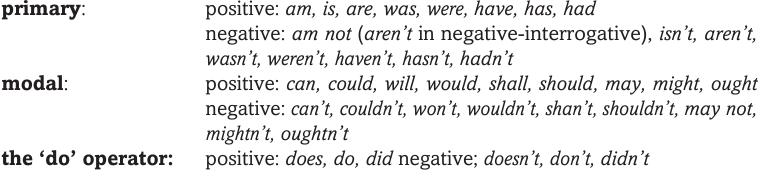
The operator is a verb, of one of the following types: primary, modal or do, as explained below.
Worthy of mention here are the lexical auxiliaries based on the primary verbs be (be about to, be sure to, be going to, etc.) and have (have to, have got to). The primary verb functions as a normal operator in these combinations.
Less commonly in use are the semi-modals dare and need, which as modals are used in negative and interrogative clauses, and admit the abbreviated forms daren’t and needn’t, respectively. (Dare you tell her? I daren’t tell her. How dare you speak to me like that? Need I go? You needn’t go).
Dare can be used with will, should and would, a possibility that is not open to modals in general: Nobody will dare vote against the proposal; I wouldn’t dare take a space-trip even if I were offered one.
Dare and need also behave like full lexical verbs requiring the do-operator: I didn’t dare go. I didn’t need to go. Didn’t you dare go? Didn’t you need to go? Didn’t dare is more common now than dared not (He dared not say a word, He didn’t dare say a word).








