Meaning-changing alternations
Causatives
We presented some Turkish examples involving CAUSATIVE verbs. One of these is repeated in(17b).
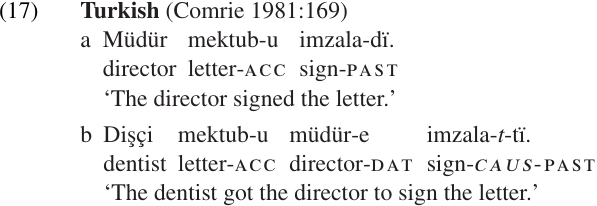
The base verb in (17a) means ‘to sign.’ The verb in (17b) carries the causative suffix,-t, and means ‘cause to sign.’ Notice that sentence (17b) also contains an extra participant. The letter and its signer (in this case the director) are participants in both clauses, but in(17b) there is a new participant who is responsible for bringing about the signing event. This new participant is referred to as the CAUSER. The participant who is caused to do something, corresponding to the subject of the base verb, is called the CAUSEE. So, in (17b) the dentist is the causer and the director is the causee.
Causatives always introduce a new participant, the causer, which is normally the subject of the derived verb.7 If the base verb is in transitive, as in the Chichewa example (18), then the derived causative will be transitive. So causative formation is a valence-increasing process.
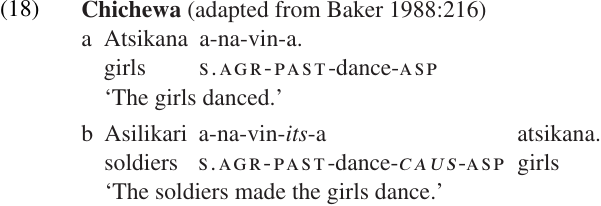
When the base verb is transitive, the derived causative will follow one of three basic subcategorization patterns. In some languages, the causee will be expressed as primary object while the patient is demoted to secondary object, as in (19b). In other languages, the causee will be expressed as a secondary object, as in (17b). The third possibility is for the causee to be expressed as an oblique argument, as in(20b).
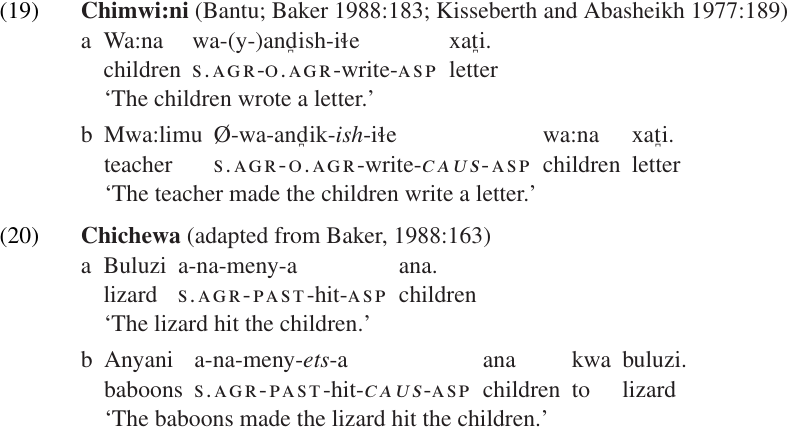
The argument structure of a causative verb derived from an intransitive base verb, like the verb in (18b), is illustrated in (21a). The corresponding diagram for a causative derived from a transitive base is shown in (21b). These diagrams indicate that the causative affix introduces an abstract cause predicate which takes two arguments: the causer (role = agent) and the caused event. The argument structure of the caused event corresponds to the argument structure of the base verb. So, the causative verb is semantically complex: it expresses two predicates, each of which takes its own arguments. But there is only one set of Grammatical Relations assigned by the verb as a whole.8
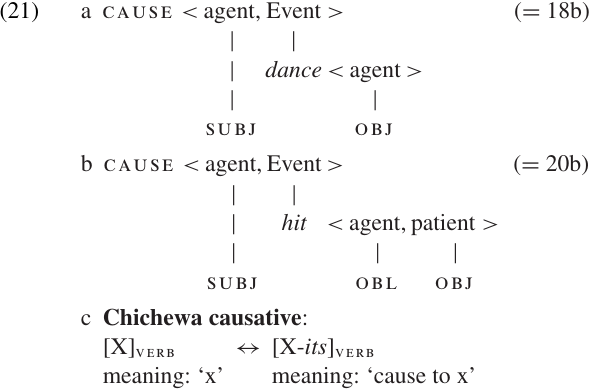
A simple WFR expressing the function of the Chichewa causative suffix is presented in (21c). The changes in argument structure and Grammatical Relations can be fairly complex, so we will simply write out the change of meaning in words.
7. That is, the causer will be the SUBJ when the causative verb appears in the active voice.
8. See Kroeger (2004), Noun classes and pronouns for a discussion of the evidence supporting this claim.








