Non-verbal predicates
We saw that many predicates impose selectional restrictions on their arguments, as illustrated in (1). Each of the verbs in these examples requires one if its arguments to belong to a particular semantic class: animate beings in (1a, c); important public figures in (1b). When these restrictions are violated, the resulting sentences are semantically odd or unacceptable.
(1) a #Mypencil doesn’t know how to spell that word.
b #John assassinated a big cockroach.
c #Mary taught her motorcycle classical Chinese.
The examples in (2a,b) also involve selectional restrictions, but with an interesting difference: the same verb is used in all of these examples, namely is. This shows that, unlike previous examples we have considered, the contrast between John is in love vs. #My guitar is in love, or #John is easy to play vs. My guitar is easy to play, etc. cannot be determined by the lexical properties of the verb itself. Rather, the words or phrases that follow the verb seem to determine the selectional restrictions on the subject of the clause.
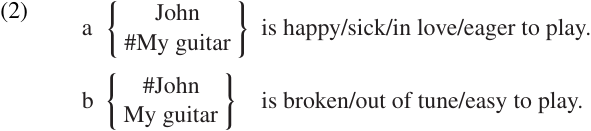
The fact that the AP and PP constituents in (2a,b) can impose selectional restrictions suggests that they are functioning as semantic predicates. Up to now, most of the clauses we have considered have contained verbal predicates, but we will examine various types of clauses whose semantic predicate is expressed by a word or phrase of some other category. (Recall that we defined a predicate as “the element of meaning which identifies the property or relationship” described by a clause.)
The verb to be, realized as is in (2a, b), has almost no meaning of its own. It is grammatically a verb, being inflected for tense and agreement, but semantically it is essentially empty. For this reason, it is often referred to as a LINKING VERB, or COPULA. The meaning of the clause is determined by the phrase which follows the linking verb, e.g. in love or eager to play in (2a). This phrase is called a PREDICATE COMPLEMENT.
The linking verb contributes very little to the meaning of a sentence, but it does satisfy a basic requirement of English grammar which states that every sentence must contain a verb. This requirement does not hold for all languages, however. In a number of languages, sentences like those in (2) would be expressed without any verb at all. Some Tagalog examples are presented in (3).1 The semantic predicates of these three sentences are expressed by phrases belonging to the categories AP, NP, and PP, respectively. (In a Tagalog verbal clause, the verb usually comes first; in non-verbal clauses, the predicate phrase normally comes first.2) In each case the English translation contains the linking verb is, but there is no corresponding form in the Tagalog.
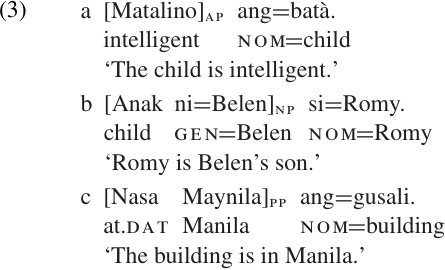
We defined a CLAUSE as the smallest grammatical unit which expresses a predicate and its arguments. The examples in (3) are unlike any we have discussed thus far in that they lack a verb; but they are still clauses under this definition, because they each contain a predicate and its argument. What is special about them is the fact that their predicates are not expressed by verbs.
English and Tagalog represent two basic patterns of clause structure involving non-verbal predicates. Many languages use a linking verb to express such predicates, as English does. In other languages, like Tagalog, no verb is needed. And there are a significant number of languages which use a linking verb in some contexts and not in others. We will discuss examples of each type.
1. Many of the Tagalog examples are taken from Schachter and Otanes (1972), often with minor modifications.
2. It would be more accurate to say that the head of the predicate phrase is normally the first element of the clause, because predicate phrases can be expressed as discontinuous constituents in Tagalog.








