Verb agreement
VERB AGREEMENT refers to a system in which the form of the verb reflects the person, number, and/or gender of one or more arguments. Verbs normally agree only with TERMS, i.e. arguments which bear the Grammatical Relations of subject, object, or secondary object. If a verb agrees with only one argument, it will be normally the subject; if two, they will be the subject and direct (or primary) object; if three, they will be the subject, primary object, and secondary object.
Modern English still retains some traces of the old subject–verb agreement pattern, which is more fully preserved in other Germanic languages. We used this fact as one of the tests for identifying the subject of a sentence in Semantic roles and Grammatical Relations. When the agreement features (specifically number and person) of the verb do not match those of the subject NP, the result is ungrammatical:
(20) a *John are my cousin.
b *John am my cousin.
c *I is a native speaker.
Portuguese is another language in which the verb agrees with its subject. Unlike English, Portuguese verbs show agreement marking in all persons and most tenses. Only the present tense forms are listed in (21).

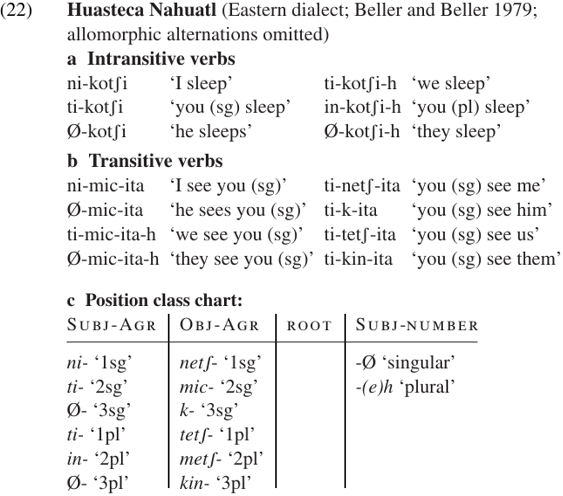
Nahuatl (or Aztec), from Mexico, is a language in which a transitive verb agrees with both subject and direct object, as illustrated in (22b). An intransitive verb, of course, agrees only with the subject (22a). Notice that, in addition to the agreement prefixes which register the person and number of the subject and object, the verb also bears a plural agreement suffix-(e)h when the subject is plural. The agreement affixes are summarized in the chart in (22c).
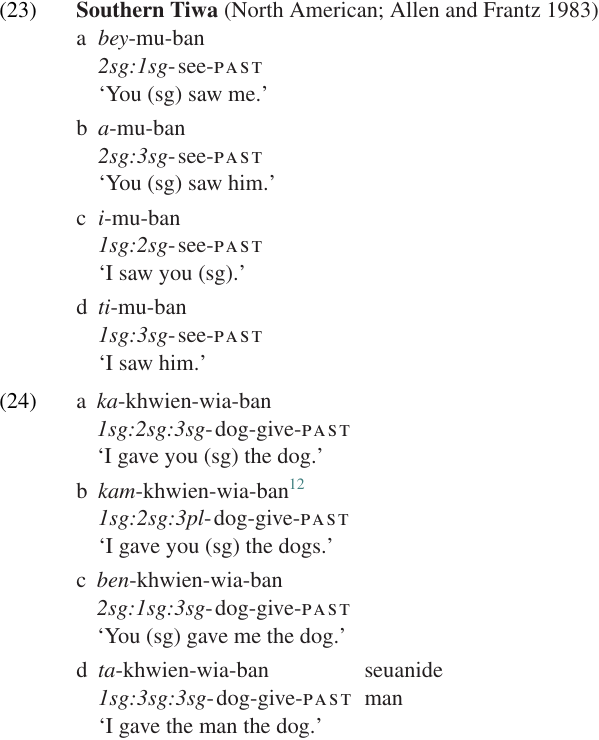
An example of a language which agrees with subject, primary object, and secondary object is Southern Tiwa.11 Agreement with these three arguments is shown in a single portmanteau prefix, as illustrated in (23–24).
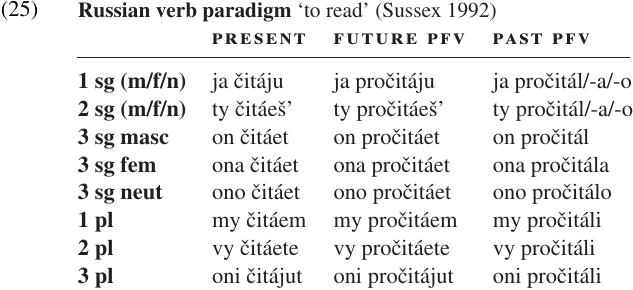
As noted above, verb agreement normally reflects the grammatical features of person, number, and/or gender. An example of verb agreement which reflects gender is found in Russian, where the verb agrees with its subject for person and number in non-past tenses, and for gender and number in past tenses.
10. These 2nd person pronouns are restricted to specific contexts in modern Portuguese: tu for indicating familiarity, and vo̒s primarily for addressing the deity in prayer (Parkinson 1992). The polite second person pronouns, você (sg.) and vocês (pl.), trigger 3rd person agreement marking on the verb.
11. Following the analysis of Rosen (1990).
12. This example is based on the data in Allen and Frantz (1983), with very slight modification.








