Applicatives
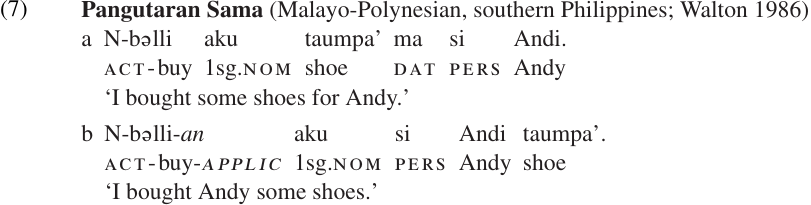
An APPLICATIVE affix is one which increases the syntactic valence of a verb by introducing a new primary object. Typically, the applicative “promotes” an oblique argument to primary object, and so does not affect the argument structure of the verb. If the verb was transitive to begin with, the derived verb will be ditransitive (taking two objects). Pangutaran Sama has a suffix-an which functions in this way, as illustrated in (7). The basic transitive verb (N) bəlli ‘buy’ can take an optional oblique beneficiary marked with ma ‘dative.’ When the applicative suffix is added to form N bəlli-an, the dative case marker is lost. There is also a change in word order, with the NP that expresses the beneficiary appearing before the patient NP.
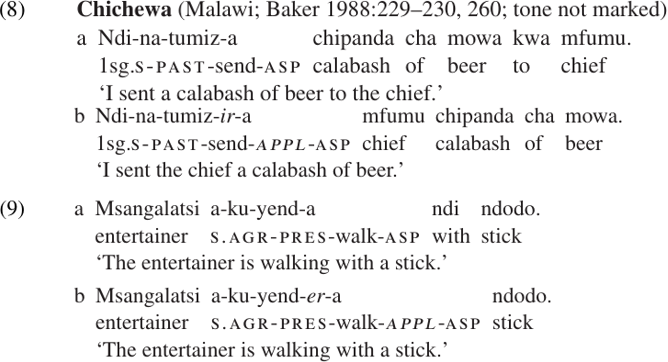
Many African languages have applicative affixes, including the Bantu language Chichewa. As the examples in (8–9) illustrate, the promoted oblique argument may be a recipient or instrument; benefactive and locative uses are also possible, but are not illustrated here. In Chichewa the oblique arguments are marked with prepositions (kwa for recipients; ndi for instruments). When the applicative suffix (-ir∼-er) is added to the verb, this argument becomes the primary object and is expressed as a bare NP.
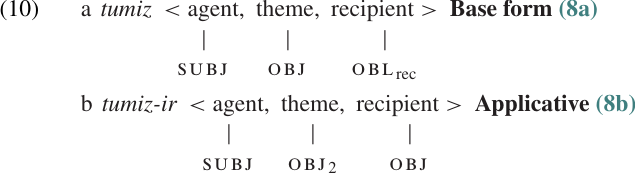
As with the passive alternation, the applicative affixes in these examples do not seem to change the basic meaning of the verb. The same participants are involved in the same type of event in both the (a) and(b) forms, suggesting that the argument structure of the verb remains the same. The effect of the applicative affix is to change the association (or linking) between semantic roles and Grammatical Relations, increasing the number of terms (i.e. the syntactic valence) by one. This change is illustrated in (10), which shows the argument structures corresponding to the sentences in (8). Again, we could express the relationship between the two verb forms with a WFR.
Notice that the beneficiary in(7a) and the instrument in (9a) are optional; so, in addition to the changes in Grammatical Relations noted above, the applicative suffixes in (7b) and (9b) change an optional argument into an obligatory argument. In some languages, applicative affixes may promote certain kinds of adjuncts to arguments, or introduce a new argument into the argument structure. However, the defining function of an applicative is to create a new primary object, and in most cases, this does not involve a change in argument structure.








