The verb channel
Depending on the adverbial function concerned, there is a wide range of verbs that supply the conceptual source for adverbial clause subordinators.
The following examples may give an impression of the variety to be found in the languages of the world.
Verbs expressing goal orientation are a not uncommon source for adverbial clauses of purpose, such verbs being, in particular, ‘give’ (Heine and Kuteva 2002a: 154–5) and ‘go to’. In the following example (61) from Thai, the verb hây ‘give’ functions as a purposive marker, while (62) illustrates the grammaticalization of the verb bang ‘go’ to-bang, a subordinating conjunction of goal or purpose, in the Central American language Rama.

‘Go’-verbs have also been widely used in creole languages to develop purpose subordinators (Bickerton 1981; Rettler 1991; Heine and Kuteva 2002a: 163–5).
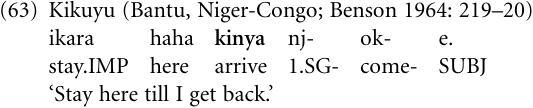
Lexical verbs may also develop into temporal clause subordinators. For example, in the Kenyan language Kikuyu, the intransitive verb-kinya ‘arrive at, come’ has given rise to a temporal conjunction kinya ‘until’, for example:
Verbal sources for adverbial-clause subordinators can also be found in conditional sentences, where the marker of the protasis clause (‘if’) may historically be derived from an imperative verb form, as in English suppose.
Examples for a development from verb to adverbial clause subordinator are also provided by signed languages. For example, in American Sign Language, the verb sign UNDERSTAND has given rise, among others, to a conjunction roughly meaning ‘provided that’, and in the Sign Language of the Netherlands (NGT), the verb sign FOLLOW can be used as a clause-linking marker introducing temporal and causal relations (‘due to’/‘after’; Pfau and Steinbach 2005a: 21).








