Valence alternations
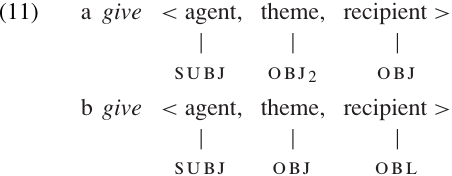
We have already seen that some verbs can be used in more than one way. In Semantic roles and Grammatical Relations, for example, we saw that the verb give occurs in two different clause patterns, as illustrated in (10). We can now see that these two uses of the verb involve the same semantic roles but a different assignment of Grammatical Relations, i.e. different sub categorization. This difference is represented in (11). The lexical entry for give must allow for both of these configurations.1
(10) a John gave Mary his old radio.
b John gave his old radio to Mary.
It is not difficult to find examples of other verbs with more than one possible valence. For example, in the following pairs of sentences we see the same verb used either with or without an object:
(12) a John has eaten his sandwich.
b John has eaten.
(13) a Bill is writing an autobiography.
b Bill is writing.
These sentences seem to show that eat and write can be either transitive or intransitive. However, the same kind of event is described in both patterns. Whenever you eat, something must get eaten; whenever you write, something must get written. So even in the (b) sentences, it seems reasonable to assume that the argument structure contains a patient, although we don’t know exactly what the patient is because it is not specified. It is even possible to refer to this unspecified patient, as illustrated in (14). The pronoun it in (14c) refers to the unspecified patient of (14b).
(14) a John: I feel hungry.
b Mary: Didn’t you eat before we left?
c John: Yes, but it wasn’t very substantial.
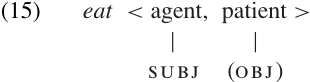
We might say that such verbs are semantically transitive, but differ from other transitive verbs in that they allow the patient argument to remain unexpressed. (For historical reasons, the pattern illustrated in (12b) and (13b) is sometimes called “unspecified object deletion.” A more precise term might be “unspecified patient suppression.”) We could represent the argument structure of these verbs as in (15), indicating that the patient may either be an OBJ, or be syntactically unexpressed:
But not all cases of variable transitivity can be treated in this way. Consider the following examples:
(16) a John is walking the dog.
b John is walking.
(17) a The sunshine is melting the snow.
b #The sunshine is melting.
c The snow is melting.
In example (16), it is not so clear that the same kind of event is described by both sentences. In (16b) John is definitely walking; but in (16a), while the dog is clearly walking, John could be riding a bicycle or roller-skating. Similarly, even though the string of words in sentence (17b) is a proper subset of sentence (17a), its meaning is quite different. Compare this example with (12) and (13) above. The sentence Bill is writing an autobiography clearly implies that Bill is writing; and John has eaten his sandwich clearly implies that John has eaten. However, sentence (17a) implies not (17b) but (17c).
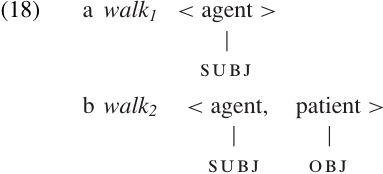
Thus, the variable transitivity in examples (16) and (17) seems to be of a different type from that in (12) and (13). For cases like (16) and (17), we might want to say that the verb simply has two different senses, each with its own argument structure (as illustrated in (18)), and both senses must be listed in the lexicon.
A number of languages have grammatical processes which, in effect, “change” an oblique argument into an object. The result is a change in the valence of the verb. This can be illustrated by the sentences in (19). In (19a), the beneficiary argument is expressed as an OBL, but in (19b) the beneficiary is expressed as an OBJ. So (19b) contains one more term than (19a), and the valence of the verb has increased from two to three; but there is no change in the number of semantic arguments. Grammatical operations which increase or decrease the valence of a verb are a topic of great interest to syntacticians.
(19) a John baked a cake for Mary.
b John baked Mary a cake.
1. The relationship between these two configurations can be expressed as a grammatical rule, since a number of other verbs allow the same kind of alternation. See Kroeger (2004, Constituent structure) for a detailed discussion of this alternation.








